
Ch 12: Fluid Mechanics
Young & Freedman Calc - University Physics 14th Edition
Young & Freedman Calc14th EditionUniversity PhysicsISBN: 9780321973610Not the one you use?Change textbook
Chapter 12, Problem 11

In intravenous feeding, a needle is inserted in a vein in the patient's arm and a tube leads from the needle to a reservoir of fluid (density 1050 kg/m3) located at height h above the arm. The top of the reservoir is open to the air. If the gauge pressure inside the vein is 5980 Pa, what is the minimum value of h that allows fluid to enter the vein? Assume the needle diameter is large enough that you can ignore the viscosity of the liquid.

Verified step by step guidance
1
Understand that the fluid will flow into the vein if the pressure at the needle is greater than the gauge pressure inside the vein. The gauge pressure is the pressure relative to atmospheric pressure.
The pressure at the needle is due to the height of the fluid column above the needle. This pressure can be calculated using the hydrostatic pressure formula: \( P = \rho g h \), where \( \rho \) is the fluid density, \( g \) is the acceleration due to gravity, and \( h \) is the height of the fluid column.
Set up the equation to find the minimum height \( h \) by equating the hydrostatic pressure to the gauge pressure inside the vein: \( \rho g h = 5980 \) Pa.
Substitute the given values into the equation: \( \rho = 1050 \) kg/m³ and \( g = 9.81 \) m/s². This gives \( 1050 \times 9.81 \times h = 5980 \).
Solve for \( h \) by rearranging the equation: \( h = \frac{5980}{1050 \times 9.81} \). This will give you the minimum height required for the fluid to enter the vein.

Verified video answer for a similar problem:

This video solution was recommended by our tutors as helpful for the problem above.
Video duration:
2m
Was this helpful?

Key Concepts

Here are the essential concepts you must grasp in order to answer the question correctly.

Fluid Pressure

Fluid pressure is the force exerted by a fluid per unit area. In this context, the pressure exerted by the fluid in the reservoir must overcome the gauge pressure in the vein for fluid to flow into it. The pressure due to the fluid column is calculated using the formula P = ρgh, where ρ is the fluid density, g is the acceleration due to gravity, and h is the height of the fluid column.
Recommended video:
Guided course
17:04
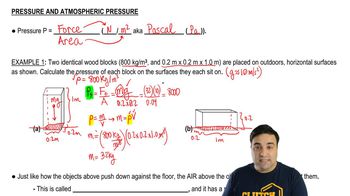
Pressure and Atmospheric Pressure

Gauge Pressure

Gauge pressure is the pressure relative to atmospheric pressure. It is the pressure inside the vein that the fluid from the reservoir must overcome to enter the vein. In this problem, the gauge pressure is given as 5980 Pa, which means the fluid pressure from the reservoir must be at least this value for fluid to flow into the vein.
Recommended video:
Guided course
09:27
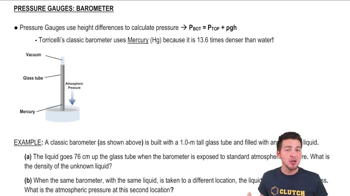
Pressure Gauges: Barometer

Hydrostatic Pressure

Hydrostatic pressure is the pressure exerted by a fluid at equilibrium due to the force of gravity. It increases with depth in the fluid. In this scenario, the hydrostatic pressure from the fluid column in the reservoir is what drives the fluid into the vein. The height h of the fluid column determines the hydrostatic pressure, which must be sufficient to overcome the vein's gauge pressure.
Recommended video:
Guided course
17:04
Pressure and Atmospheric Pressure
Related Practice
Textbook Question

Oceans on Mars. Scientists have found evidence that Mars may once have had an ocean 0.500 km deep. The acceleration due to gravity on Mars is 3.71 m/s2. (a) What would be the gauge pressure at the bottom of such an ocean, assuming it was freshwater? (b) To what depth would you need to go in the earth's ocean to experience the same gauge pressure?

2
views
Textbook Question

You are designing a diving bell to withstand the pressure of seawater at a depth of 250 m. (a) What is the gauge pressure at this depth? (You can ignore changes in the density of the water with depth.)

1
views
Textbook Question

A cube 5.0 cm on each side is made of a metal alloy. After you drill a cylindrical hole 2.0 cm in diameter all the way through and perpendicular to one face, you find that the cube weighs 6.30 N. What is the density of this metal?

1
views
Textbook Question

Gold Brick.You win the lottery and decide to impress your friends by exhibiting a million-dollar cube of gold. At the time, gold is selling for \$1282 per troy ounce, and 1.0000 troy ounce equals 31.1035 g. How tall would your million-dollar cube be?

1
views
Textbook Question

You are designing a diving bell to withstand the pressure of seawater at a depth of 250 m. What is the gauge pressure at this depth? (You can ignore changes in the density of the water with depth.) At this depth, what is the net force due to the water outside and the air inside the bell on a circular glass window 30.0 cm in diameter if the pressure inside the diving bell equals the pressure at the surface of the water? (Ignore the small variation of pressure over the surface of the window.)

2
views
Textbook Question

A barrel contains a 0.120-m layer of oil floating on water that is 0.250 m deep. The density of the oil is 600 kg/m3. (a) What is the gauge pressure at the oil–water interface? (b) What is the gauge pressure at the bottom of the barrel?