A small circular hole 6.00 mm in diameter is cut in the side of a large water tank, 14.0 m below the water level in the tank. The top of the tank is open to the air. Find (a) the speed of efflux of the water and (b) the volume discharged per second.
BIO. Artery Blockage. A medical technician is trying to determine what percentage of a patient's artery is blocked by plaque. To do this, she measures the blood pressure just before the region of blockage and finds that it is 1.20×10⁴ Pa, while in the region of blockage it is 1.15×10⁴ Pa. Furthermore, she knows that blood flowing through the normal artery just before the point of blockage is traveling at 30.0 cm/s, and the specific gravity of this patient's blood is 1.06. What percentage of the cross-sectional area of the patient's artery is blocked by the plaque?
Verified step by step guidance
Verified video answer for a similar problem:
Key Concepts
Bernoulli's Principle
Continuity Equation
Specific Gravity
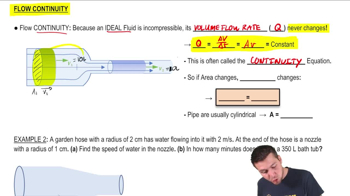
Home Repair. You need to extend a 2.50-inch-diameter pipe, but you have only a 1.00-inch-diameter pipe on hand. You make a fitting to connect these pipes end to end. If the water is flowing at 6.00 cm/s in the wide pipe, how fast will it be flowing through the narrow one?
A shower head has 20 circular openings, each with radius 1.0 mm. The shower head is connected to a pipe with radius 0.80 cm. If the speed of water in the pipe is 3.0 m/s, what is its speed as it exits the shower-head openings?
A soft drink (mostly water) flows in a pipe at a beverage plant with a mass flow rate that would fill 220 0.355-L cans per minute. At point 2 in the pipe, the gauge pressure is 152 kPa and the cross-sectional area is 8.00 cm2. At point 1, 1.35 m above point 2, the cross-sectional area is 2.00 cm2. Find the (b) volume flow rate. (c) flow speeds at points 1 and 2.
Water is flowing in a pipe with a varying cross-sectional area, and at all points the water completely fills the pipe. At point 1 the cross-sectional area of the pipe is 0.070 m2, and the magnitude of the fluid velocity is 3.50 m/s. (c) Calculate the volume of water discharged from the open end of the pipe in 1.00 hour.
At one point in a pipeline the water's speed is 3.00 m/s and the gauge pressure is 5.00×10⁴ Pa. Find the gauge pressure at a second point in the line, 11.0 m lower than the first, if the pipe diameter at the second point is twice that at the first.
