Ch 10: Dynamics of Rotational Motion
Young & Freedman Calc - University Physics 14th Edition
Young & Freedman Calc14th EditionUniversity PhysicsISBN: 9780321973610Not the one you use?Change textbook
Chapter 10, Problem 51a

The rotor (flywheel) of a toy gyroscope has mass 0.140 kg. Its moment of inertia about its axis is 1.20 × 10⁻⁴ kg m2. The mass of the frame is 0.0250 kg. The gyroscope is supported on a single pivot (Fig. E10.51) with its center of mass a horizontal distance of 4.00 cm from the pivot. The gyroscope is precessing in a horizontal plane at the rate of one revolution in 2.20 s. Find the upward force exerted by the pivot.
<Image>

Verified step by step guidance
1
First, identify the forces acting on the gyroscope. The gyroscope is supported by a pivot, which exerts an upward force to balance the weight of the gyroscope and its frame.
Calculate the total weight of the gyroscope system. The weight is the sum of the weight of the rotor and the frame. Use the formula for weight: \( W = mg \), where \( m \) is the mass and \( g \) is the acceleration due to gravity (approximately 9.81 m/s²).
The mass of the rotor is 0.140 kg and the mass of the frame is 0.0250 kg. Add these masses to find the total mass: \( m_{total} = m_{rotor} + m_{frame} \).
Calculate the total weight using the total mass: \( W_{total} = m_{total} \times g \).
The upward force exerted by the pivot must be equal to the total weight of the gyroscope system to maintain equilibrium. Therefore, the upward force \( F_{pivot} \) is equal to \( W_{total} \).

Verified video answer for a similar problem:

This video solution was recommended by our tutors as helpful for the problem above.
Video duration:
5m
Was this helpful?

Key Concepts

Here are the essential concepts you must grasp in order to answer the question correctly.

Moment of Inertia

Moment of inertia is a measure of an object's resistance to changes in its rotation rate. It depends on the mass distribution relative to the axis of rotation. For the gyroscope, the moment of inertia about its axis is given as 1.20 * 10^-4 kg•m^2, which is crucial for calculating rotational dynamics and understanding how the gyroscope behaves when spinning.
Recommended video:
Guided course
11:47
Intro to Moment of Inertia

Precession

Precession is the phenomenon where the axis of a spinning object, like a gyroscope, slowly rotates around another axis due to external forces. In this problem, the gyroscope precesses in a horizontal plane at a rate of one revolution every 2.20 seconds. This motion is influenced by the torque resulting from the gravitational force acting on the gyroscope's center of mass, which is offset from the pivot.

Torque and Equilibrium

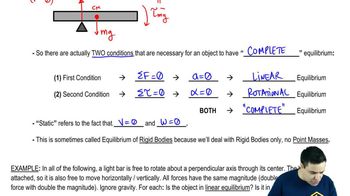
Torque is a measure of the force that can cause an object to rotate about an axis. In equilibrium, the sum of forces and torques acting on a system is zero. For the gyroscope, the upward force exerted by the pivot must balance the gravitational force acting on the gyroscope's mass, ensuring rotational equilibrium. Calculating this force involves considering the gyroscope's mass, the distance from the pivot, and the gravitational acceleration.
Recommended video:
Guided course
10:13
Torque & Equilibrium
Related Practice
Textbook Question

A uniform, 4.5-kg, square, solid wooden gate 1.5 m on each side hangs vertically from a frictionless pivot at the center of its upper edge. A 1.1-kg raven flying horizontally at 5.0 m/s flies into this door at its center and bounces back at 2.0 m/s in the opposite direction. During the collision, why is the angular momentum conserved but not the linear momentum?

3
views
Textbook Question

A thin uniform rod has a length of 0.500 m0.500\(\text{ m}\) and is rotating in a circle on a frictionless table. The axis of rotation is perpendicular to the length of the rod at one end and is stationary. The rod has an angular velocity of 0.400 rad/s0.400\(\text{ rad/s}\) and a moment of inertia about the axis of 3.00×10³kg/m23.00\(\times\)10^{-3}\(\text{kg/m}\)^2. A bug initially standing on the rod at the axis of rotation decides to crawl out to the other end of the rod. When the bug has reached the end of the rod and sits there, its tangential speed is 0.160 m/s0.160\(\text{ m/s}\). The bug can be treated as a point mass. What is the mass of the rod.

2
views
Textbook Question

A certain gyroscope precesses at a rate of 0.50 rad/s when used on earth. If it were taken to a lunar base, where the acceleration due to gravity is 0.165g, what would be its precession rate?

Textbook Question

A uniform, 4.5-kg, square, solid wooden gate 1.5 m on each side hangs vertically from a frictionless pivot at the center of its upper edge. A 1.1-kg raven flying horizontally at 5.0 m/s flies into this door at its center and bounces back at 2.0 m/s in the opposite direction. What is the angular speed of the gate just after it is struck by the unfortunate raven?

17
views