
Ch 10: Dynamics of Rotational Motion
Young & Freedman Calc - University Physics 14th Edition
Young & Freedman Calc14th EditionUniversity PhysicsISBN: 9780321973610Not the one you use?Change textbook
Chapter 10, Problem 12b

A stone is suspended from the free end of a wire that is wrapped around the outer rim of a pulley, similar to what is shown in Fig. 10.10. The pulley is a uniform disk with mass 10.0 kg and radius 30.0 cm and turns on frictionless bearings. You measure that the stone travels 12.6 m in the first 3.00 s starting from rest. Find the tension in the wire.

Verified step by step guidance
1
First, identify the given values: the mass of the pulley (m_p = 10.0 kg), the radius of the pulley (r = 0.30 m), the distance traveled by the stone (d = 12.6 m), and the time taken (t = 3.00 s). The stone starts from rest, so its initial velocity (v_0) is 0 m/s.
Calculate the acceleration of the stone using the kinematic equation: d = v_0 * t + (1/2) * a * t^2. Since v_0 = 0, the equation simplifies to d = (1/2) * a * t^2. Solve for acceleration (a) using MathML: a=2dt2.
Next, calculate the angular acceleration of the pulley. The linear acceleration of the stone is related to the angular acceleration (α) of the pulley by the equation: a = α * r. Solve for α using MathML: α=ar.
Determine the moment of inertia (I) of the pulley, which is a uniform disk. The formula for the moment of inertia of a disk is: I = (1/2) * m_p * r^2. Use MathML to express this: I=12m_pr2.
Finally, apply Newton's second law for rotation to find the tension (T) in the wire. The net torque (τ) on the pulley is given by τ = I * α. The torque due to the tension is τ = T * r. Set these equal and solve for T using MathML: T=Iαr.

Verified video answer for a similar problem:

This video solution was recommended by our tutors as helpful for the problem above.
Video duration:
6m
Was this helpful?

Key Concepts

Here are the essential concepts you must grasp in order to answer the question correctly.

Rotational Motion

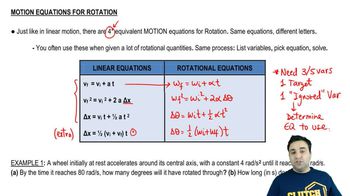
Rotational motion involves objects that rotate around an axis. In this scenario, the pulley acts as a uniform disk, and its rotation is influenced by the tension in the wire and the mass of the stone. Understanding rotational motion is crucial for analyzing how the stone's movement affects the pulley's rotation and vice versa.
Recommended video:
Guided course
07:18
Equations of Rotational Motion

Newton's Second Law

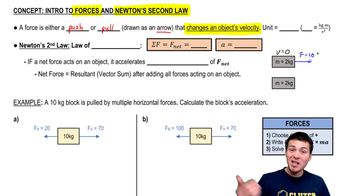
Newton's Second Law states that the force acting on an object is equal to the mass of the object multiplied by its acceleration (F = ma). This principle is essential for calculating the tension in the wire, as it helps determine the net force acting on the stone, considering its mass and the acceleration derived from its motion.
Recommended video:
Guided course
06:54
Intro to Forces & Newton's Second Law

Kinematics

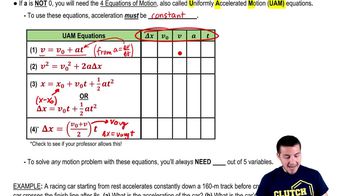
Kinematics is the study of motion without considering the forces that cause it. In this problem, kinematic equations are used to determine the stone's acceleration from its initial rest position, distance traveled, and time taken. This information is vital for applying Newton's Second Law to find the tension in the wire.
Recommended video:
Guided course
08:25
Kinematics Equations
Related Practice
Textbook Question

A 2.00-kg textbook rests on a frictionless, horizontal surface. A cord attached to the book passes over a pulley whose diameter is 0.150 m, to a hanging book with mass 3.00 kg. The system is released from rest, and the books are observed to move 1.20 m in 0.800 s. What is the tension in each part of the cord?

2
views
Textbook Question

A machine part has the shape of a solid uniform sphere of mass 225 g and diameter 3.00 cm. It is spinning about a frictionless axle through its center, but at one point on its equator it is scraping against metal, resulting in a friction force of 0.0200 N at that point. How long will it take to decrease its rotational speed by 22.5 rad/s?

1
views
Textbook Question

A stone is suspended from the free end of a wire that is wrapped around the outer rim of a pulley, similar to what is shown in Fig. 10.10. The pulley is a uniform disk with mass 10.0 kg and radius 30.0 cm and turns on frictionless bearings. You measure that the stone travels 12.6 m in the first 3.00 s starting from rest. Find the mass of the stone.

2
views
Textbook Question

A 15.0-kg bucket of water is suspended by a very light rope wrapped around a solid uniform cylinder 0.300 m in diameter with mass 12.0 kg. The cylinder pivots on a frictionless axle through its center. The bucket is released from rest at the top of a well and falls 10.0 m to the water. With what speed does the bucket strike the water?

1
views
Textbook Question

A machine part has the shape of a solid uniform sphere of mass 225 g and diameter 3.00 cm. It is spinning about a frictionless axle through its center, but at one point on its equator, it is scraping against metal, resulting in a friction force of 0.0200 N at that point. Find its angular acceleration.

1
views
Textbook Question

A 12.0-kg box resting on a horizontal, frictionless surface is attached to a 5.00-kg weight by a thin, light wire that passes over a frictionless pulley (Fig. E10.16). The pulley has the shape of a uniform solid disk of mass 2.00 kg and diameter 0.500 m. After the system is released, find the acceleration of the box.

1
views