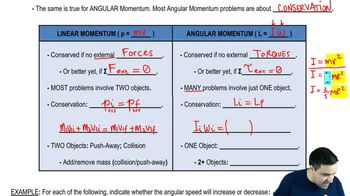
A solid wood door 1.00 m wide and 2.00 m high is hinged along one side and has a total mass of 40.0 kg. Initially open and at rest, the door is struck at its center by a handful of sticky mud with mass 0.500 kg, traveling perpendicular to the door at 12.0 m/s just before impact. Find the final angular speed of the door. Does the mud make a significant contribution to the moment of inertia?
A large wooden turntable in the shape of a flat uniform disk has a radius of 2.00 m and a total mass of 120 kg. The turntable is initially rotating at 3.00 rad/s about a vertical axis through its center. Suddenly, a 70.0-kg parachutist makes a soft landing on the turntable at a point near the outer edge. Find the angular speed of the turntable after the parachutist lands. (Assume that you can treat the parachutist as a particle.)
Verified step by step guidance
Verified video answer for a similar problem:
Key Concepts
Conservation of Angular Momentum
Moment of Inertia
Angular Speed
Under some circumstances, a star can collapse into an extremely dense object made mostly of neutrons and called a neutron star. The density of a neutron star is roughly times as great as that of ordinary solid matter. Suppose we represent the star as a uniform, solid, rigid sphere, both before and after the collapse. The star's initial radius was (comparable to our sun); its final radius is 16 km. If the original star rotated once in days, find the angular speed of the neutron star.
A large wooden turntable in the shape of a flat uniform disk has a radius of 2.00 m and a total mass of 120 kg. The turntable is initially rotating at 3.00 rad/s about a vertical axis through its center. Suddenly, a 70.0-kg parachutist makes a soft landing on the turntable at a point near the outer edge. Compute the kinetic energy of the system before and after the parachutist lands. Why are these kinetic energies not equal?
A small 10.0-g bug stands at one end of a thin uniform bar that is initially at rest on a smooth horizontal table. The other end of the bar pivots about a nail driven into the table and can rotate freely, without friction. The bar has mass 50.0 g and is 100 cm in length. The bug jumps off in the horizontal direction, perpendicular to the bar, with a speed of 20.0 cm/s relative to the table. What is the angular speed of the bar just after the frisky insect leaps?
The Spinning Figure Skater. The outstretched hands and arms of a figure skater preparing for a spin can be considered a slender rod pivoting about an axis through its center (Fig. E10.43). When the skater's hands and arms are brought in and wrapped around his body to execute the spin, the hands and arms can be considered a thinwalled, hollow cylinder. His hands and arms have a combined mass of 8.0 kg. When outstretched, they span 1.8 m; when wrapped, they form a cylinder of radius 25 cm. The moment of inertia about the rotation axis of the remainder of his body is constant and equal to 0.40 kg m2 . If his original angular speed is 0.40 rev/s, what is his final angular speed?
Suppose that an asteroid traveling straight toward the center of the earth were to collide with our planet at the equator and bury itself just below the surface. What would have to be the mass of this asteroid, in terms of the earth's mass M, for the day to become 25.0% longer than it presently is as a result of the collision? Assume that the asteroid is very small compared to the earth and that the earth is uniform throughout.
