Ch 10: Dynamics of Rotational Motion
Young & Freedman Calc - University Physics 14th Edition
Young & Freedman Calc14th EditionUniversity PhysicsISBN: 9780321973610Not the one you use?Change textbook
Chapter 10, Problem 10.38a

(a) Calculate the magnitude of the angular momentum of the earth in a circular orbit around the sun. Is it reasonable to model it as a particle? Consult Appendix E and the astronomical data in Appendix F

Verified step by step guidance
1
Identify the formula for angular momentum of a particle in circular motion: \( L = mvr \), where \( m \) is the mass, \( v \) is the velocity, and \( r \) is the radius of the orbit.
Determine the mass of the Earth \( m \) from Appendix E or F. This is typically given as \( 5.97 \times 10^{24} \) kg.
Find the average distance from the Earth to the Sun, which is the radius \( r \) of the Earth's orbit. This is approximately \( 1.496 \times 10^{11} \) meters.
Calculate the orbital velocity \( v \) of the Earth. Use the formula \( v = \frac{2\pi r}{T} \), where \( T \) is the orbital period of the Earth (1 year or \( 365.25 \times 24 \times 3600 \) seconds).
Substitute the values of \( m \), \( v \), and \( r \) into the angular momentum formula \( L = mvr \) to find the magnitude of the Earth's angular momentum. Consider whether treating the Earth as a particle is reasonable by comparing the size of the Earth to the size of its orbit.

Verified video answer for a similar problem:

This video solution was recommended by our tutors as helpful for the problem above.
Video duration:
4m
Was this helpful?

Key Concepts

Here are the essential concepts you must grasp in order to answer the question correctly.

Angular Momentum

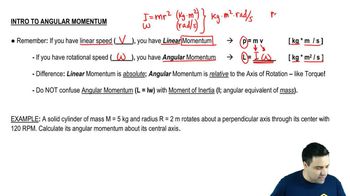
Angular momentum is a measure of the rotational motion of an object and is given by the product of the object's moment of inertia and its angular velocity. For a particle moving in a circular orbit, it can be calculated using L = mvr, where m is mass, v is tangential velocity, and r is the radius of the orbit.
Recommended video:
Guided course
06:18
Intro to Angular Momentum

Moment of Inertia

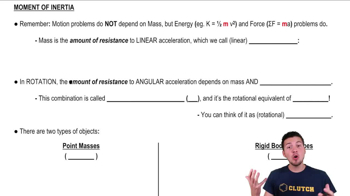
Moment of inertia is a property of a body that defines its resistance to angular acceleration, depending on the mass distribution relative to the axis of rotation. For a point mass, it is calculated as I = mr², where m is the mass and r is the distance from the axis, crucial for determining angular momentum in orbital systems.
Recommended video:
Guided course
11:47
Intro to Moment of Inertia

Modeling as a Particle

Modeling the Earth as a particle simplifies calculations by treating it as a point mass located at its center of mass. This approximation is reasonable for large-scale orbital dynamics where the size and shape of the Earth have negligible effects on its motion around the Sun, allowing for easier computation of angular momentum.
Recommended video:
Guided course
07:21
Ideal Gases and the Ideal Gas Law
Related Practice
Textbook Question

A cord is wrapped around the rim of a solid uniform wheel 0.250 m in radius and of mass 9.20 kg. A steady horizontal pull of 40.0 N to the right is exerted on the cord, pulling it off tangentially from the wheel. The wheel is mounted on frictionless bearings on a horizontal axle through its center. Find the magnitude and direction of the force that the axle exerts on the wheel.

3
views
Textbook Question

A machine part has the shape of a solid uniform sphere of mass 225 g and diameter 3.00 cm. It is spinning about a frictionless axle through its center, but at one point on its equator it is scraping against metal, resulting in a friction force of 0.0200 N at that point. How long will it take to decrease its rotational speed by 22.5 rad/s?

1
views
Textbook Question

Three forces are applied to a wheel of radius 0.350 m, as shown in Fig. E10.4. One force is perpendicular to the rim, one is tangent to it, and the other one makes a 40.0° angle with the radius. What is the net torque on the wheel due to these three forces for an axis perpendicular to the wheel and passing through its center?

1
views
Textbook Question

A machinist is using a wrench to loosen a nut. The wrench is 25.0 cm long, and he exerts a 17.0-N force at the end of the handle at 37° with the handle (Fig. E10.7). What is the maximum torque he could exert with this force, and how should the force be oriented?

2
views
Textbook Question

The flywheel of an engine has moment of inertia 1.60 kg/m2 about its rotation axis. What constant torque is required to bring it up to an angular speed of 400 rev/min in 8.00 s, starting from rest?

1
views
Textbook Question

A machine part has the shape of a solid uniform sphere of mass 225 g and diameter 3.00 cm. It is spinning about a frictionless axle through its center, but at one point on its equator, it is scraping against metal, resulting in a friction force of 0.0200 N at that point. Find its angular acceleration.

1
views