Ch 08: Momentum, Impulse, and Collisions
Young & Freedman Calc - University Physics 14th Edition
Young & Freedman Calc14th EditionUniversity PhysicsISBN: 9780321973610Not the one you use?Change textbook
Chapter 8, Problem 34a

Two fun-loving otters are sliding toward each other on a muddy (and hence frictionless) horizontal surface. One of them, of mass 7.50 kg, is sliding to the left at 5.00 m/s, while the other, of mass 5.75 kg, is slipping to the right at 6.00 m/s. They hold fast to each other after they collide. Find the magnitude and direction of the velocity of these free-spirited otters right after they collide.

Verified step by step guidance
1
Step 1: Identify the principle of conservation of momentum, which states that the total momentum of a system remains constant if no external forces act on it. In this case, the collision is frictionless, so momentum is conserved.
Step 2: Write the equation for the total momentum before and after the collision. The total momentum before the collision is the sum of the individual momenta of the two otters: \( p_{\text{total, before}} = m_1 v_1 + m_2 v_2 \), where \( m_1 \) and \( v_1 \) are the mass and velocity of the first otter, and \( m_2 \) and \( v_2 \) are the mass and velocity of the second otter.
Step 3: Substitute the given values into the equation for the total momentum before the collision. Note that the direction of motion matters: assign a positive sign to the velocity of the otter moving to the right and a negative sign to the velocity of the otter moving to the left. Thus, \( v_1 = -5.00 \, \text{m/s} \) and \( v_2 = 6.00 \, \text{m/s} \).
Step 4: After the collision, the two otters stick together and move as a single object. The total momentum after the collision is \( p_{\text{total, after}} = (m_1 + m_2) v_{\text{final}} \), where \( v_{\text{final}} \) is the velocity of the combined mass. Set \( p_{\text{total, before}} = p_{\text{total, after}} \) to solve for \( v_{\text{final}} \).
Step 5: Rearrange the equation to solve for \( v_{\text{final}} \): \( v_{\text{final}} = \frac{m_1 v_1 + m_2 v_2}{m_1 + m_2} \). Substitute the values for \( m_1 \), \( m_2 \), \( v_1 \), and \( v_2 \) into this equation to find the magnitude and direction of the final velocity of the otters after the collision.

Verified video answer for a similar problem:

This video solution was recommended by our tutors as helpful for the problem above.
Video duration:
6m
Was this helpful?

Key Concepts

Here are the essential concepts you must grasp in order to answer the question correctly.

Conservation of Momentum

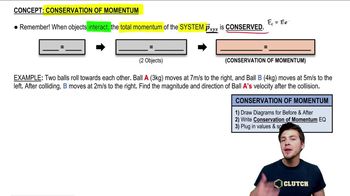
The principle of conservation of momentum states that in a closed system, the total momentum before an event (like a collision) is equal to the total momentum after the event. This is crucial for solving collision problems, as it allows us to calculate the final velocities of objects involved in the collision by equating the total momentum before and after.
Recommended video:
Guided course
05:58
Conservation Of Momentum

Momentum Calculation

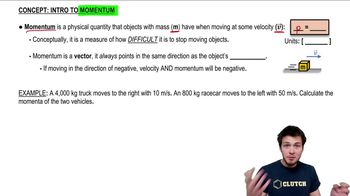
Momentum is defined as the product of an object's mass and its velocity (p = mv). In this scenario, we calculate the momentum of each otter before the collision by multiplying their respective masses by their velocities. The direction of the momentum is also important, as it indicates the direction of motion, which will affect the final result after the collision.
Recommended video:
Guided course
05:17
Intro to Momentum

Elastic vs. Inelastic Collisions

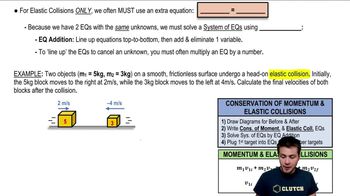
Collisions can be classified as elastic or inelastic. Inelastic collisions are those where the objects stick together after colliding, conserving momentum but not kinetic energy. In this problem, since the otters hold fast to each other after colliding, we treat it as an inelastic collision, which simplifies the calculation of their combined velocity post-collision.
Recommended video:
Guided course
08:56
Intro To Elastic Collisions
Related Practice
Textbook Question

Two ice skaters, Daniel (mass 65.0 kg) and Rebecca (mass 45.0 kg), are practicing. Daniel stops to tie his shoelace and, while at rest, is struck by Rebecca, who is moving at 13.0 m/s before she collides with him. After the collision, Rebecca has a velocity of magnitude 8.00 m/s at an angle of 53.1° from her initial direction. Both skaters move on the frictionless, horizontal surface of the rink. What are the magnitude and direction of Daniel's velocity after the collision?

2
views
Textbook Question

To protect their young in the nest, peregrine falcons will fly into birds of prey (such as ravens) at high speed. In one such episode, a 600-g falcon flying at 20.0 m/s hit a 1.50-kg raven flying at 9.0 m/s. The falcon hit the raven at right angles to its original path and bounced back at 5.0 m/s. (These figures were estimated by the author as he watched this attack occur in northern New Mexico.) By what angle did the falcon change the raven's direction of motion?

2
views
Textbook Question

Two skaters collide and grab on to each other on frictionless ice. One of them, of mass 70.0 kg, is moving to the right at 4.00 m/s, while the other, of mass 65.0 kg, is moving to the left at 2.50 m/s. What are the magnitude and direction of the velocity of these skaters just after they collide?

2
views
Textbook Question

Two fun-loving otters are sliding toward each other on a muddy (and hence frictionless) horizontal surface. One of them, of mass 7.50 kg, is sliding to the left at 5.00 m/s, while the other, of mass 5.75 kg, is slipping to the right at 6.00 m/s. They hold fast to each other after they collide. How much mechanical energy dissipates during this play?

3
views
Textbook Question

Jack (mass 55.0 kg) is sliding due east with speed 8.00 m/s on the surface of a frozen pond. He collides with Jill (mass 48.0 kg), who is initially at rest. After the collision, Jack is traveling at 5.00 m/s in a direction 34.0° north of east. What is Jill's velocity (magnitude and direction) after the collision? Ignore friction.

1
views
Textbook Question

Two ice skaters, Daniel (mass 65.0 kg) and Rebecca (mass 45.0 kg), are practicing. Daniel stops to tie his shoelace and, while at rest, is struck by Rebecca, who is moving at 13.0 m/s before she collides with him. After the collision, Rebecca has a velocity of magnitude 8.00 m/s at an angle of 53.1° from her initial direction. Both skaters move on the frictionless, horizontal surface of the rink. What is the change in total kinetic energy of the two skaters as a result of the collision?

1
views