
Ch 08: Momentum, Impulse, and Collisions
Young & Freedman Calc - University Physics 14th Edition
Young & Freedman Calc14th EditionUniversity PhysicsISBN: 9780321973610Not the one you use?Change textbook
Chapter 8, Problem 15

To warm up for a match, a tennis player hits the 57.0-g ball vertically with her racket. If the ball is stationary just before it is hit and goes 5.50 m high, what impulse did she impart to it?

Verified step by step guidance
1
Convert the mass of the tennis ball from grams to kilograms. Since 1 gram = 0.001 kilograms, the mass of the ball is \( m = 57.0 \times 10^{-3} \; \text{kg} \).
Determine the velocity of the ball at the peak of its motion. At the peak, the velocity is zero, but we need to calculate the initial velocity imparted to the ball. Use the kinematic equation \( v^2 = u^2 + 2as \), where \( v = 0 \; \text{m/s} \) (final velocity at the peak), \( a = -9.8 \; \text{m/s}^2 \) (acceleration due to gravity), and \( s = 5.50 \; \text{m} \) (height). Solve for \( u \), the initial velocity.
Once the initial velocity \( u \) is determined, calculate the change in momentum (\( \Delta p \)) of the ball. Momentum is given by \( p = mv \), so \( \Delta p = m \cdot u - m \cdot 0 \), where \( u \) is the initial velocity and the initial momentum is zero because the ball was stationary.
Recall that impulse (\( J \)) is equal to the change in momentum, \( J = \Delta p \). Use the value of \( \Delta p \) calculated in the previous step to find the impulse imparted to the ball.
Ensure all units are consistent (mass in kilograms, velocity in meters per second, impulse in Newton-seconds) and verify the calculations for accuracy.

Verified video answer for a similar problem:

This video solution was recommended by our tutors as helpful for the problem above.
Video duration:
7m
Was this helpful?

Key Concepts

Here are the essential concepts you must grasp in order to answer the question correctly.

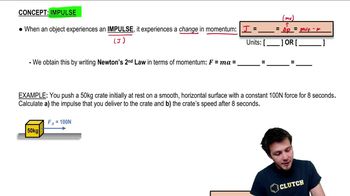
Impulse

Impulse is defined as the change in momentum of an object when a force is applied over a period of time. It is calculated as the product of the average force and the time duration over which the force acts. In this context, the impulse imparted to the tennis ball can be determined by analyzing its change in velocity as it moves from rest to its peak height.
Recommended video:
Guided course
06:00
Impulse & Impulse-Momentum Theorem

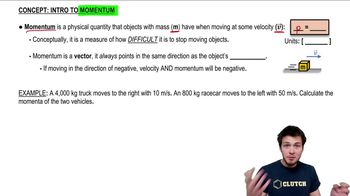
Momentum

Momentum is a vector quantity defined as the product of an object's mass and its velocity. It is conserved in isolated systems, meaning that the total momentum before an event equals the total momentum after. In this scenario, the momentum of the tennis ball changes from zero (at rest) to a value determined by its mass and the velocity it reaches at the peak height.
Recommended video:
Guided course
05:17
Intro to Momentum

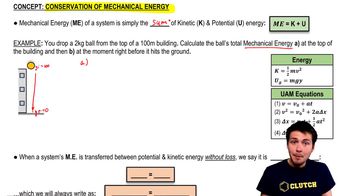
Kinematics and Energy Conservation

Kinematics involves the study of motion without considering the forces that cause it. The conservation of energy principle states that energy cannot be created or destroyed, only transformed. In this problem, the kinetic energy imparted to the ball by the racket is converted into gravitational potential energy as the ball rises to its maximum height, allowing us to relate height to the initial velocity and thus to the impulse.
Recommended video:
Guided course
06:24
Conservation Of Mechanical Energy
Related Practice
Textbook Question

On a frictionless, horizontal air table, puck A (with mass 0.250 kg) is moving toward puck B (with mass 0.350 kg), which is initially at rest. After the collision, puck A has a velocity of 0.120 m/s to the left, and puck B has a velocity of 0.650 m/s to the right. What was the speed of puck A before the collision?

2
views
Textbook Question

Two vehicles are approaching an intersection. One is a 2500-kg pickup traveling at 14.0 m/s from east to west (the -x-direction), and the other is a 1500-kg sedan going from south to north (the +y-direction) at 23.0 m/s. What are the magnitude and direction of the net momentum?

3
views
Textbook Question

Two vehicles are approaching an intersection. One is a 2500-kg pickup traveling at 14.0 m/s from east to west (the -x-direction), and the other is a 1500-kg sedan going from south to north (the +y-direction) at 23.0 m/s. Find the x- and y-components of the net momentum of this system.

4
views
Textbook Question

You are standing on a sheet of ice that covers the football stadium parking lot in Buffalo; there is negligible friction between your feet and the ice. A friend throws you a 0.600-kg ball that is traveling horizontally at 10.0 m/s. Your mass is 70.0 kg. If the ball hits you and bounces off your chest, so afterward it is moving horizontally at 8.0 m/s in the opposite direction, what is your speed after the collision?

3
views
Textbook Question

You are standing on a sheet of ice that covers the football stadium parking lot in Buffalo; there is negligible friction between your feet and the ice. A friend throws you a 0.600-kg ball that is traveling horizontally at 10.0 m/s. Your mass is 70.0 kg. If you catch the ball, with what speed do you and the ball move afterward?

2
views