
Ch 06: Work & Kinetic Energy
Young & Freedman Calc - University Physics 14th Edition
Young & Freedman Calc14th EditionUniversity PhysicsISBN: 9780321973610Not the one you use?Change textbook
Chapter 6, Problem 3a

A factory worker pushes a 30.030.0-kg crate a distance of 4.54.5 m along a level floor at constant velocity by pushing horizontally on it. The coefficient of kinetic friction between the crate and the floor is 0.250.25. What magnitude of force must the worker apply?

Verified step by step guidance
1
Identify the forces acting on the crate: The crate is subject to gravitational force (weight), normal force, frictional force, and the applied force by the worker. Since the crate moves at constant velocity, the net force in the horizontal direction is zero (Newton's First Law).
Calculate the gravitational force (weight) acting on the crate using the formula: Fg=mg, where m is the mass of the crate (30.0 kg) and g is the acceleration due to gravity (9.8 m/s²).
Determine the normal force acting on the crate. Since the floor is level and there is no vertical motion, the normal force is equal in magnitude and opposite in direction to the gravitational force: Fn=Fg.
Calculate the frictional force using the formula: Ff=μkFn, where μk is the coefficient of kinetic friction (0.25) and Fn is the normal force.
Set the applied force equal to the frictional force to maintain constant velocity: Fa=Ff. Substitute the values calculated in the previous steps to find the magnitude of the applied force.

Verified video answer for a similar problem:

This video solution was recommended by our tutors as helpful for the problem above.
Video duration:
2m
Was this helpful?

Key Concepts

Here are the essential concepts you must grasp in order to answer the question correctly.

Newton's Second Law of Motion

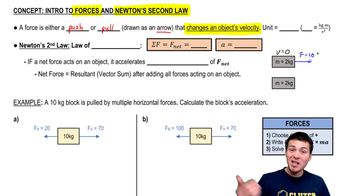
Newton's Second Law states that the acceleration of an object is directly proportional to the net force acting on it and inversely proportional to its mass. In this scenario, since the crate is moving at a constant velocity, the net force is zero, meaning the applied force must equal the frictional force opposing the motion.
Recommended video:
Guided course
06:54
Intro to Forces & Newton's Second Law

Friction

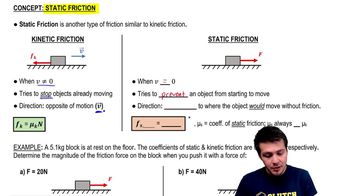
Friction is the force that opposes the relative motion of two surfaces in contact. The coefficient of kinetic friction quantifies this force, calculated as the product of the normal force and the coefficient. In this case, the frictional force can be determined using the crate's weight and the given coefficient of kinetic friction.
Recommended video:
Guided course
08:11
Static Friction & Equilibrium

Normal Force

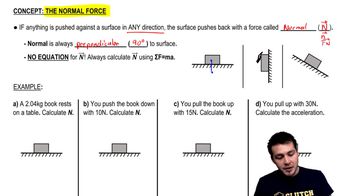
The normal force is the force exerted by a surface to support the weight of an object resting on it, acting perpendicular to the surface. For the crate on a level floor, the normal force equals the gravitational force acting on the crate, which is its weight. This force is crucial for calculating the frictional force that the worker must overcome.
Recommended video:
Guided course
08:17
The Normal Force