
Ch 04: Newton's Laws of Motion
Young & Freedman Calc - University Physics 14th Edition
Young & Freedman Calc14th EditionUniversity PhysicsISBN: 9780321973610Not the one you use?Change textbook
Chapter 4, Problem 4a

A man is dragging a trunk up the loading ramp of a mover's truck. The ramp has a slope angle of 20.020.0°, and the man pulls upward with a force F\(\overrightarrow{F}\) whose direction makes an angle of 30.030.0° with the ramp (Fig. E4.44.4). How large a force F\(\overrightarrow{F}\) is necessary for the component FxF_{x} parallel to the ramp to be 90.090.0 N?
<IMAGE>

Verified step by step guidance
1
Step 1: Understand the problem. The goal is to find the magnitude of the force F→ such that its component parallel to the ramp (Fx) equals 90.0 N. The ramp is inclined at an angle of 20.0°, and the force F→ is applied at an angle of 30.0° relative to the ramp.
Step 2: Recall the relationship between the components of a force and its direction. The parallel component Fx of the force F→ can be expressed as Fx = F * cos(θ), where θ is the angle between the force and the direction of the ramp.
Step 3: Substitute the given values into the formula. Here, Fx = 90.0 N and θ = 30.0°. The equation becomes 90.0 = F * cos(30.0°).
Step 4: Solve for F. Rearrange the equation to isolate F: F = Fx / cos(30.0°).
Step 5: Use the cosine function to calculate cos(30.0°). You can then substitute this value into the equation to find the magnitude of F. Note that cos(30.0°) is a standard trigonometric value, approximately equal to √3/2.

Verified video answer for a similar problem:

This video solution was recommended by our tutors as helpful for the problem above.
Video duration:
3m
Was this helpful?

Key Concepts

Here are the essential concepts you must grasp in order to answer the question correctly.

Force Components

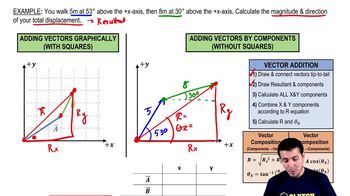
In physics, forces can be broken down into components that act along specific directions. For a force F acting at an angle, its components can be calculated using trigonometric functions: Fx = F * cos(θ) and Fy = F * sin(θ). Understanding how to resolve forces into their components is crucial for analyzing situations involving inclined planes and angles.
Recommended video:
Guided course
07:30
Vector Addition By Components

Inclined Plane

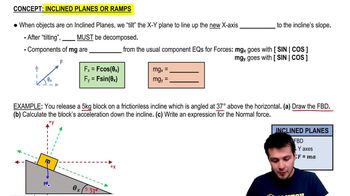
An inclined plane is a flat surface tilted at an angle to the horizontal, which affects the forces acting on objects moving along it. The gravitational force acting on an object can be decomposed into two components: one parallel to the incline, which causes the object to slide down, and one perpendicular to the incline, which affects the normal force. The angle of the incline plays a significant role in determining these forces.
Recommended video:
Guided course
06:59
Intro to Inclined Planes

Newton's Second Law

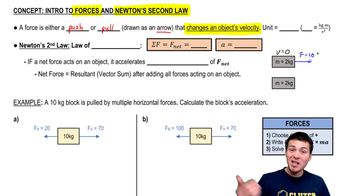
Newton's Second Law states that the acceleration of an object is directly proportional to the net force acting on it and inversely proportional to its mass, expressed as F = ma. This principle is essential for understanding how forces interact in a system, particularly when calculating the necessary force to achieve a specific acceleration or to counteract other forces, such as friction or gravity on an incline.
Recommended video:
Guided course
06:54
Intro to Forces & Newton's Second Law
Related Practice
Textbook Question

You walk into an elevator, step onto a scale, and push the 'up' button. You recall that your normal weight is 625625 N. Draw a free-body diagram. When the elevator has an upward acceleration of magnitude 2.502.50 m/s2, what does the scale read?

2
views
Textbook Question

To extricate an SUV stuck in the mud, workmen use three horizontal ropes, producing the force vectors shown in Fig. E4.24.2. Find the xx- and yy-components of each of the three pulls.

4
views
Textbook Question

Due to a jaw injury, a patient must wear a strap (Fig. E4.34.3) that produces a net upward force of 5.005.00 N on his chin. The tension is the same throughout the strap. To what tension must the strap be adjusted to provide the necessary upward force?

<IMAGE>

2
views
Textbook Question

A man is dragging a trunk up the loading ramp of a mover's truck. The ramp has a slope angle of 20.020.0°, and the man pulls upward with a force F\(\overrightarrow{F}\) whose direction makes an angle of 30.030.0° with the ramp (Fig. E4.44.4). How large will the component FyF_y perpendicular to the ramp be then?

<IMAGE>

Textbook Question

To extricate an SUV stuck in the mud, workmen use three horizontal ropes, producing the force vectors shown in Fig. E4.24.2. Use the components to find the magnitude and direction of the resultant of the three pulls.

1
views
Textbook Question

You walk into an elevator, step onto a scale, and push the 'up' button. You recall that your normal weight is 625625 N. Draw a free-body diagram. If you hold a 3.853.85-kg package by a light vertical string, what will be the tension in this string when the elevator accelerates as in part (a)? Note: Part (a) asked what does the scale read when the elevator has an upward acceleration of magnitude 2.502.50 m/s2.

3
views