
Ch 04: Newton's Laws of Motion
Young & Freedman Calc - University Physics 14th Edition
Young & Freedman Calc14th EditionUniversity PhysicsISBN: 9780321973610Not the one you use?Change textbook
Chapter 4, Problem 11b

A hockey puck with mass 0.1600.160 kg is at rest at the origin (x=0x = 0) on the horizontal, frictionless surface of the rink. At time t=0t = 0 a player applies a force of 0.2500.250 N to the puck, parallel to the xx-axis; she continues to apply this force until t=2.00t = 2.00 s. If the same force is again applied at t=5.00t = 5.00 s, what are the position and speed of the puck at t=7.00t = 7.00 s?

Verified step by step guidance
1
Step 1: Begin by analyzing the motion of the puck during the first interval (t = 0 to t = 2.00 s). Use Newton's second law, \( F = ma \), to calculate the acceleration of the puck. The force \( F \) is given as 0.250 N, and the mass \( m \) is 0.160 kg. Solve for acceleration \( a \) using \( a = \frac{F}{m} \).
Step 2: Using the calculated acceleration \( a \), determine the velocity of the puck at t = 2.00 s. Since the puck starts from rest, the velocity \( v \) can be found using the kinematic equation \( v = v_0 + at \), where \( v_0 \) is the initial velocity (0 m/s). Substitute \( a \) and \( t = 2.00 \) s into the equation.
Step 3: Calculate the position of the puck at t = 2.00 s using the kinematic equation \( x = x_0 + v_0t + \frac{1}{2}at^2 \). Here, \( x_0 \) is the initial position (0 m), \( v_0 \) is the initial velocity (0 m/s), and \( a \) is the acceleration calculated earlier. Substitute \( t = 2.00 \) s into the equation.
Step 4: For the second interval (t = 5.00 s to t = 7.00 s), note that the puck moves with constant velocity from t = 2.00 s to t = 5.00 s (no force is applied during this time). Use the velocity at t = 2.00 s to calculate the position of the puck at t = 5.00 s using \( x = x_0 + vt \), where \( v \) is the constant velocity and \( x_0 \) is the position at t = 2.00 s.
Step 5: When the force is reapplied at t = 5.00 s, the puck undergoes acceleration again. Repeat the process from Step 1 to calculate the new acceleration, velocity, and position during the interval t = 5.00 s to t = 7.00 s. Add the displacement during this interval to the position at t = 5.00 s to find the final position at t = 7.00 s. Use \( v = v_0 + at \) to find the final velocity at t = 7.00 s.

Verified video answer for a similar problem:

This video solution was recommended by our tutors as helpful for the problem above.
Video duration:
15m
Was this helpful?

Key Concepts

Here are the essential concepts you must grasp in order to answer the question correctly.

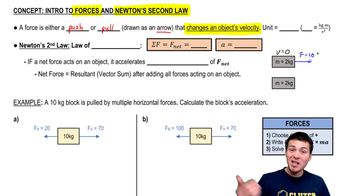
Newton's Second Law of Motion

Newton's Second Law states that the acceleration of an object is directly proportional to the net force acting on it and inversely proportional to its mass. This relationship is expressed by the formula F = ma, where F is the force, m is the mass, and a is the acceleration. In this scenario, the force applied to the hockey puck will determine its acceleration, which can be calculated to find its velocity and position over time.
Recommended video:
Guided course
06:54
Intro to Forces & Newton's Second Law

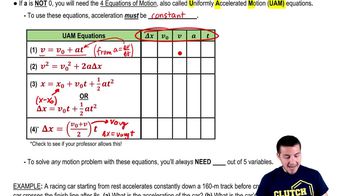
Kinematics Equations

Kinematics equations describe the motion of objects under constant acceleration. These equations relate displacement, initial velocity, final velocity, acceleration, and time. For the hockey puck, we can use these equations to calculate its position and speed at specific times, taking into account the periods of force application and the resulting acceleration.
Recommended video:
Guided course
08:25
Kinematics Equations

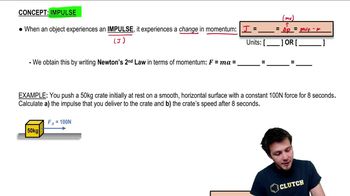
Impulse and Momentum

Impulse is the change in momentum of an object when a force is applied over a period of time. It is calculated as the product of the force and the time duration for which it acts. In this problem, understanding how the applied force affects the puck's momentum during the intervals of force application is crucial for determining its final speed and position at t = 7.00 s.
Recommended video:
Guided course
06:00
Impulse & Impulse-Momentum Theorem
Related Practice
Textbook Question

A box rests on a frozen pond, which serves as a frictionless horizontal surface. If a fisherman applies a horizontal force with magnitude 48.048.0 N to the box and produces an acceleration of magnitude 2.202.20 m/s2, what is the mass of the box?

4
views
Textbook Question

A 4.504.50-kg experimental cart undergoes an acceleration in a straight line (the xx-axis). The graph in Fig. E4.134.13 shows this acceleration as a function of time. During what times is the net force on the cart a constant?

1
views
Textbook Question

A dockworker applies a constant horizontal force of 80.080.0 N to a block of ice on a smooth horizontal floor. The frictional force is negligible. The block starts from rest and moves 11.011.0 m in 5.00 5.00 s. What is the mass of the block of ice?

1
views
Textbook Question

A small 8.008.00-kg rocket burns fuel that exerts a time-varying upward force on the rocket (assume constant mass) as the rocket moves upward from the launch pad. This force obeys the equation F=A+Bt2F=A+Bt^2. Measurements show that at t=0t = 0, the force is 100.0100.0 N, and at the end of the first 2.002.00 s, it is 150.0150.0 N. Find the constants AA and BB, including their SI units.

2
views
Textbook Question

A 4.504.50-kg experimental cart undergoes an acceleration in a straight line (the xx-axis). The graph in Fig. E4.134.13 shows this acceleration as a function of time. Find the maximum net force on this cart. When does this maximum force occur?

2
views
Textbook Question

A hockey puck with mass 0.1600.160 kg is at rest at the origin (x=0x = 0) on the horizontal, frictionless surface of the rink. At time t=0t = 0 a player applies a force of 0.2500.250 N to the puck, parallel to the xx-axis; she continues to apply this force until t=2.00t = 2.00 s. What are the position and speed of the puck at t=2.00t = 2.00 s?

1
views