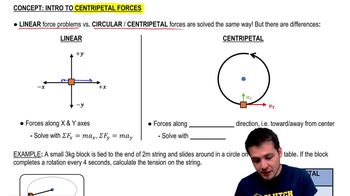
At its Ames Research Center, NASA uses its large '20-G' centrifuge to test the effects of very large accelerations ('hypergravity') on test pilots and astronauts. In this device, an arm 8.84 m long rotates about one end in a horizontal plane, and an astronaut is strapped in at the other end. Suppose that he is aligned along the centrifuge's arm with his head at the outermost end. The maximum sustained acceleration to which humans are subjected in this device is typically 12.5g. How fast must the astronaut's head be moving to experience this maximum acceleration?
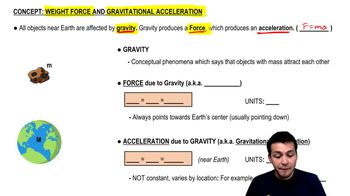
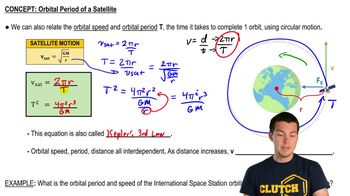
The earth has a radius of 6380 km and turns around once on its axis in 24 h. If arad at the equator is greater than g, objects will fly off the earth's surface and into space. (We will see the reason for this in Chapter 5.) What would the period of the earth's rotation have to be for this to occur?
Verified step by step guidance
Verified video answer for a similar problem:
Key Concepts
Centripetal Acceleration
Gravitational Acceleration
Rotational Period
A model of a helicopter rotor has four blades, each 3.40 m long from the central shaft to the blade tip. The model is rotated in a wind tunnel at 550 rev/min. What is the radial acceleration of the blade tip expressed as a multiple of g?
A model of a helicopter rotor has four blades, each 3.40 m long from the central shaft to the blade tip. The model is rotated in a wind tunnel at 550 rev/min. What is the linear speed of the blade tip, in m/s?
The earth has a radius of 6380 km and turns around once on its axis in 24 h. What is the radial acceleration of an object at the earth's equator? Give your answer in m/s2 and as a fraction of g.
A 124 kg balloon carrying a 22 kg basket is descending with a constant downward velocity of 20.0 m/s. A 1.0 kg stone is thrown from the basket with an initial velocity of 15.0 m/s perpendicular to the path of the descending balloon, as measured relative to a person at rest in the basket. That person sees the stone hit the ground 5.00 s after it was thrown. Assume that the balloon continues its downward descent with the same constant speed of 20.0 m/s. How high is the balloon when the rock is thrown?
A 124 kg balloon carrying a 22 kg basket is descending with a constant downward velocity of 20.0 m/s. A 1.0 kg stone is thrown from the basket with an initial velocity of 15.0 m/s perpendicular to the path of the descending balloon, as measured relative to a person at rest in the basket. That person sees the stone hit the ground 5.00 s after it was thrown. Assume that the balloon continues its downward descent with the same constant speed of 20.0 m/s. At the instant the rock hits the ground, how far is it from the basket?
