A rookie quarterback throws a football with an initial upward velocity component of 12.0 m/s and a horizontal velocity component of 20.0 m/s. Ignore air resistance. How much time (after it is thrown) is required for the football to return to its original level? How does this compare with the time calculated in part (a)?
A rookie quarterback throws a football with an initial upward velocity component of 12.0 m/s and a horizontal velocity component of 20.0 m/s. Ignore air resistance. How much time is required for the football to reach the highest point of the trajectory?
Verified step by step guidance
Verified video answer for a similar problem:
Key Concepts
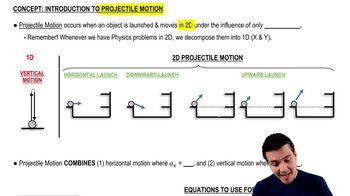
Projectile Motion
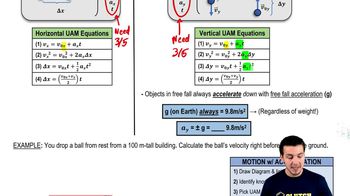
Vertical Motion Under Gravity
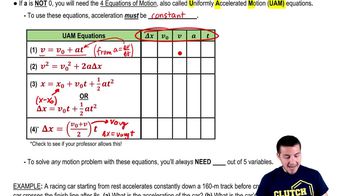
Kinematic Equations
A daring 510 N swimmer dives off a cliff with a running horizontal leap, as shown in Fig. E3.10. What must her minimum speed be just as she leaves the top of the cliff so that she will miss the ledge at the bottom, which is 1.75 m wide and 9.00 m below the top of the cliff?
A rookie quarterback throws a football with an initial upward velocity component of 12.0 m/s and a horizontal velocity component of 20.0 m/s. Ignore air resistance. How high is this point?
A rookie quarterback throws a football with an initial upward velocity component of 12.0 m/s and a horizontal velocity component of 20.0 m/s. Ignore air resistance. How far has the football traveled horizontally during this time?
Crickets Chirpy and Milada jump from the top of a vertical cliff. Chirpy drops downward and reaches the ground in 2.70 s, while Milada jumps horizontally with an initial speed of 95.0 cm/s. How far from the base of the cliff will Milada hit the ground? Ignore air resistance.
A physics book slides off a horizontal tabletop with a speed of 1.10 m/s. It strikes the floor in 0.480 s. Ignore air resistance. Find the height of the tabletop above the floor.
