Two piers, A and B, are located on a river; B is 1500 m downstream from A (Fig. E3.32). Two friends must make round trips from pier A to pier B and return. One rows a boat at a constant speed of 4.00 km/h relative to the water; the other walks on the shore at a constant speed of 4.00 km/h. The velocity of the river is 2.80 km/h in the direction from A to B. How much time does it take each person to make the round trip?
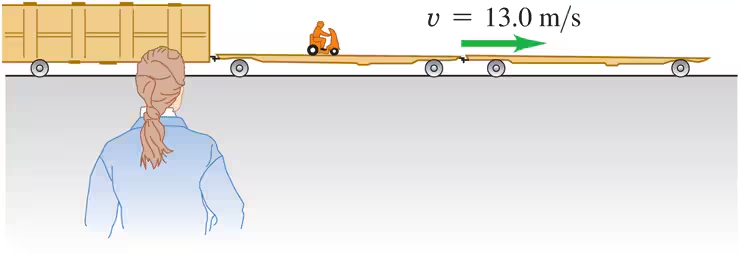
A railroad flatcar is traveling to the right at a speed of 13.0 m/s relative to an observer standing on the ground. Someone is riding a motor scooter on the flatcar (Fig. E3.30). What is the velocity (magnitude and direction) of the scooter relative to the flatcar if the scooter's velocity relative to the observer on the ground is 18.0 m/s to the right?

Verified step by step guidance
Verified video answer for a similar problem:
Key Concepts
Relative Velocity
Reference Frames
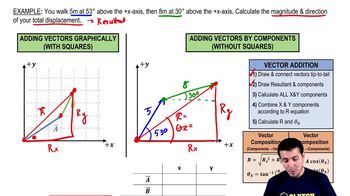
Vector Addition
At its Ames Research Center, NASA uses its large '20-G' centrifuge to test the effects of very large accelerations ('hypergravity') on test pilots and astronauts. In this device, an arm 8.84 m long rotates about one end in a horizontal plane, and an astronaut is strapped in at the other end. Suppose that he is aligned along the centrifuge's arm with his head at the outermost end. The maximum sustained acceleration to which humans are subjected in this device is typically 12.5g. How fast must the astronaut's head be moving to experience this maximum acceleration?
At its Ames Research Center, NASA uses its large '20-G' centrifuge to test the effects of very large accelerations ('hypergravity') on test pilots and astronauts. In this device, an arm 8.84 m long rotates about one end in a horizontal plane, and an astronaut is strapped in at the other end. Suppose that he is aligned along the centrifuge's arm with his head at the outermost end. The maximum sustained acceleration to which humans are subjected in this device is typically 12.5g. How fast in rpm (rev/min) is the arm turning to produce the maximum sustained acceleration?
At its Ames Research Center, NASA uses its large '20-G' centrifuge to test the effects of very large accelerations ('hypergravity') on test pilots and astronauts. In this device, an arm 8.84 m long rotates about one end in a horizontal plane, and an astronaut is strapped in at the other end. Suppose that he is aligned along the centrifuge's arm with his head at the outermost end. The maximum sustained acceleration to which humans are subjected in this device is typically 12.5g. What is the difference between the acceleration of his head and feet if the astronaut is 2.00 m tall?
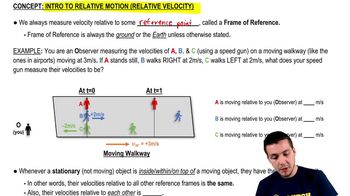
A 'moving sidewalk' in an airport terminal moves at 1.0 m/s and is 35.0 m long. If a woman steps on at one end and walks at 1.5 m/s relative to the moving sidewalk, how much time does it take her to reach the opposite end if she walks In the opposite direction?
A 'moving sidewalk' in an airport terminal moves at 1.0 m/s and is 35.0 m long. If a woman steps on at one end and walks at 1.5 m/s relative to the moving sidewalk, how much time does it take her to reach the opposite end if she walks in the same direction the sidewalk is moving?
