Ch 02: Motion Along a Straight Line
Young & Freedman Calc - University Physics 14th Edition
Young & Freedman Calc14th EditionUniversity PhysicsISBN: 9780321973610Not the one you use?Change textbook
Chapter 2, Problem 2a

In an experiment, a shearwater (a seabird) was taken from its nest, flown 5150 5150 km away, and released. The bird found its way back to its nest 13.513.5 days after release. If we place the origin at the nest and extend the +x+x–axis to the release point, what was the bird's average velocity in m/s for the return flight?

Verified step by step guidance
1
Understand the concept of average velocity, which is defined as the total displacement divided by the total time taken. In this case, the displacement is the distance from the release point back to the nest, which is 5150 km.
Convert the displacement from kilometers to meters to ensure consistency in units. Since 1 km = 1000 m, multiply 5150 km by 1000 to get the displacement in meters.
Convert the time taken for the bird to return to its nest from days to seconds. Since 1 day = 24 hours, 1 hour = 60 minutes, and 1 minute = 60 seconds, multiply 13.5 days by 24, then by 60, and then by 60 again to get the time in seconds.
Use the formula for average velocity: \( v_{avg} = \frac{\Delta x}{\Delta t} \), where \( \Delta x \) is the displacement in meters and \( \Delta t \) is the time in seconds.
Substitute the values obtained for displacement and time into the average velocity formula to find the bird's average velocity in meters per second.

Verified video answer for a similar problem:

This video solution was recommended by our tutors as helpful for the problem above.
Video duration:
2m
Was this helpful?

Key Concepts

Here are the essential concepts you must grasp in order to answer the question correctly.

Average Velocity

Average velocity is defined as the total displacement divided by the total time taken for that displacement. It is a vector quantity, meaning it has both magnitude and direction. In this context, the displacement is the straight-line distance from the release point back to the nest, and the time is the duration of the bird's return journey.
Recommended video:
Guided course
05:44
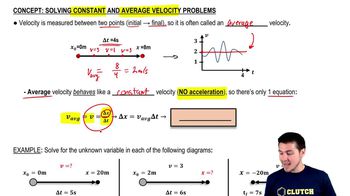
Solving Constant and Average Velocity Problems

Displacement

Displacement refers to the change in position of an object and is a vector quantity. It is the shortest distance from the initial to the final position of the object, along with the direction. For the shearwater, the displacement is the direct distance from the release point back to its nest, which is 5150 km.
Recommended video:
Guided course
06:13
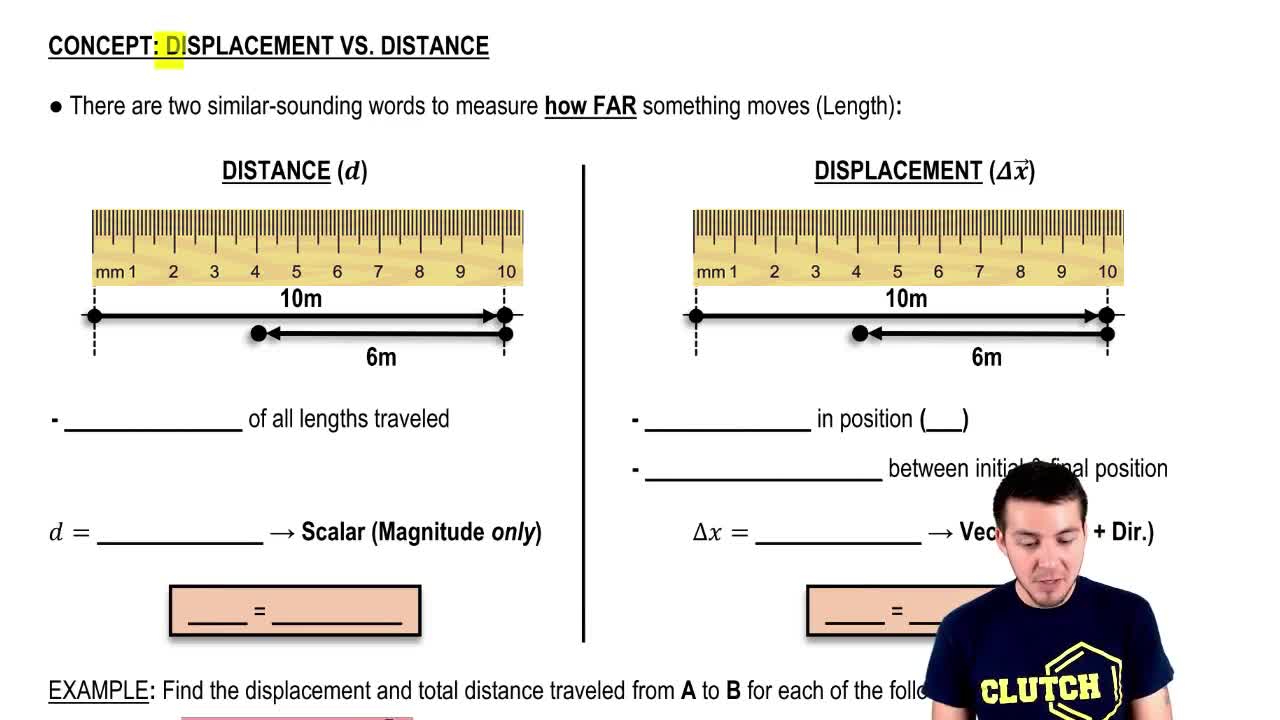
Displacement vs. Distance

Unit Conversion

Unit conversion is the process of converting a measure from one unit to another. In this problem, the distance is given in kilometers and time in days, but the average velocity needs to be calculated in meters per second. This requires converting kilometers to meters and days to seconds to ensure consistent units for velocity calculation.
Recommended video:
Guided course
07:46
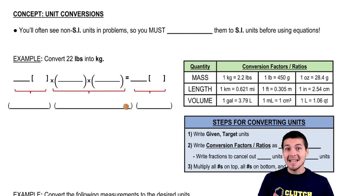
Unit Conversions