Ch 02: Motion Along a Straight Line
Young & Freedman Calc - University Physics 14th Edition
Young & Freedman Calc14th EditionUniversity PhysicsISBN: 9780321973610Not the one you use?Change textbook
Chapter 2, Problem 17a

A car's velocity as a function of time is given byvx(t)=α+βt2 v_x(t) = α + βt^2, where α=3.00α = 3.00 m/s and β=0.100β = 0.100 m/s3. Calculate the average acceleration for the time interval t=0t = 0 to t=5.00t = 5.00 s.

Verified step by step guidance
1
Understand the problem: We need to calculate the average acceleration of a car over a given time interval using the velocity function v_x(t) = α + βt^2, where α = 3.00 m/s and β = 0.100 m/s^3.
Recall the formula for average acceleration: Average acceleration is defined as the change in velocity divided by the change in time. Mathematically, it is expressed as: ΔvΔt.
Calculate the initial and final velocities: Use the given velocity function v_x(t) = α + βt^2 to find the initial velocity at t = 0 and the final velocity at t = 5.00 s. Substitute t = 0 and t = 5.00 s into the equation to find v_x(0) and v_x(5).
Determine the change in velocity: Calculate the change in velocity by subtracting the initial velocity from the final velocity: Δv = v_x(5) - v_x(0).
Calculate the average acceleration: Use the formula for average acceleration with the calculated change in velocity and the time interval (5.00 s - 0 s) to find the average acceleration: ΔvΔt.

Verified video answer for a similar problem:

This video solution was recommended by our tutors as helpful for the problem above.
Video duration:
2m
Was this helpful?

Key Concepts

Here are the essential concepts you must grasp in order to answer the question correctly.

Velocity as a Function of Time

Velocity as a function of time describes how an object's speed and direction change over time. In this problem, the velocity is given by the equation v_x(t) = α + βt^2, where α is the initial velocity and βt^2 represents the change in velocity over time due to acceleration. Understanding this equation is crucial for determining how velocity evolves during the specified time interval.
Recommended video:
Guided course
05:59
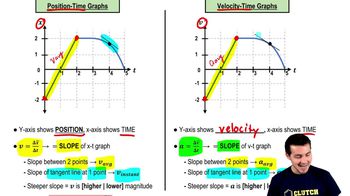
Velocity-Time Graphs & Acceleration

Average Acceleration

Average acceleration is defined as the change in velocity divided by the time over which the change occurs. It provides a measure of how quickly an object's velocity changes on average over a given time period. In this problem, calculating the average acceleration involves finding the difference in velocity at the start and end of the time interval and dividing by the duration of the interval.
Recommended video:
Guided course
05:44
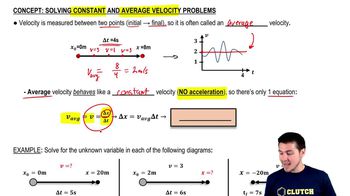
Solving Constant and Average Velocity Problems

Integration of Velocity Function

To find the change in velocity over a time interval when given a velocity function, one can integrate the function with respect to time. In this context, integrating the velocity function v_x(t) = α + βt^2 from t = 0 to t = 5.00 s will yield the total change in velocity, which is necessary for calculating the average acceleration. This process involves applying basic calculus principles to solve the problem.
Recommended video:
Guided course
11:43
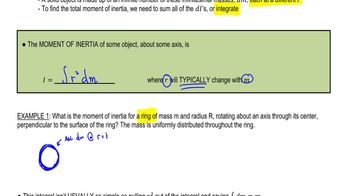
Finding Moment Of Inertia By Integrating
Related Practice
Textbook Question

An antelope moving with constant acceleration covers the distance between two points 70.070.0 m apart in 6.006.00 s. Its speed as it passes the second point is 15.015.0 m/s. What is its acceleration?

3
views

Textbook Question

A car's velocity as a function of time is given byvx(t)=α+βt2 v_x(t) = α + βt^2, where α=3.00α = 3.00 m/s and β=0.100β = 0.100 m/s3. Draw vxv_x-tt and axa_x-tt graphs for the car's motion between t=0 t = 0 and t=5.00t = 5.00 s.

1
views
Textbook Question

An astronaut has left the International Space Station to test a new space scooter. Her partner measures the following velocity changes, each taking place in a 1010-s interval. What are the magnitude, the algebraic sign, and the direction of the average acceleration in each interval? Assume that the positive direction is to the right.

(a) At the beginning of the interval, the astronaut is moving toward the right along the xx-axis at 15.015.0 m/s, and at the end of the interval she is moving toward the right at 5.05.0 m/s.

(b) At the beginning she is moving toward the left at 5.05.0 m/s, and at the end she is moving toward the left at 15.015.0 m/s.

(c) At the beginning she is moving toward the right at 15.015.0 m/s, and at the end she is moving toward the left at 15.015.0 m/s.

3
views
Textbook Question

A turtle crawls along a straight line, which we will call the xx-axis with the positive direction to the right. The equation for the turtle's position as a function of time is x(t)=50.0x(t) = 50.0 cm + (2.002.00 cm/s)tt − (0.06250.0625 cm/s2)t2t^2. At what time tt is the velocity of the turtle zero?

1
views
Textbook Question

A turtle crawls along a straight line, which we will call the xx-axis with the positive direction to the right. The equation for the turtle's position as a function of time is x(t)=50.0x(t) = 50.0 cm + (2.002.00 cm/s)tt − (0.06250.0625 cm/s2)t2t^2. Sketch graphs of xx versus tt, vxv_{x} versus tt, and axa_{x} versus tt, for the time interval t=0t = 0 to t=40t = 40 s.

1
views
Textbook Question

The fastest measured pitched baseball left the pitcher's hand at a speed of 45.045.0 m/s. If the pitcher was in contact with the ball over a distance of 1.501.50 m and produced constant acceleration, what acceleration did he give the ball?

2
views