Ch 02: Motion Along a Straight Line
Young & Freedman Calc - University Physics 14th Edition
Young & Freedman Calc14th EditionUniversity PhysicsISBN: 9780321973610Not the one you use?Change textbook
Chapter 2, Problem 35a

If a flea can jump straight up to a height of 0.4400.440 m, what is its initial speed as it leaves the ground?

Verified step by step guidance
1
Identify the known values: the maximum height (h) the flea can jump is 0.440 m, and the acceleration due to gravity (g) is approximately 9.81 m/s² downward.
Use the kinematic equation for vertical motion that relates initial velocity (v₀), final velocity (v), acceleration (a), and displacement (s): v² = v₀² + 2as. Here, the final velocity (v) at the maximum height is 0 m/s, the displacement (s) is 0.440 m, and the acceleration (a) is -9.81 m/s² (negative because it acts downward).
Rearrange the equation to solve for the initial velocity (v₀): v₀² = v² - 2as. Substitute the known values into the equation: v₀² = 0 - 2(-9.81 m/s²)(0.440 m).
Calculate the expression inside the square root: v₀² = 2 * 9.81 m/s² * 0.440 m.
Take the square root of the result to find the initial speed (v₀) of the flea as it leaves the ground.

Verified video answer for a similar problem:

This video solution was recommended by our tutors as helpful for the problem above.
Video duration:
2m
Was this helpful?

Key Concepts

Here are the essential concepts you must grasp in order to answer the question correctly.

Kinematics Equations

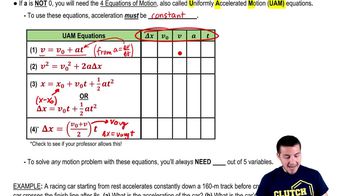
Kinematics equations describe the motion of objects without considering the forces that cause the motion. For vertical motion, the equation v^2 = u^2 + 2as can be used, where v is the final velocity, u is the initial velocity, a is the acceleration due to gravity, and s is the displacement. This equation helps determine the initial speed of the flea.
Recommended video:
Guided course
08:25
Kinematics Equations

Gravitational Acceleration

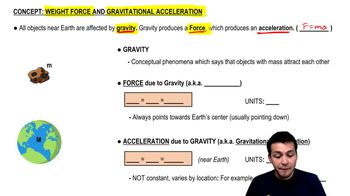
Gravitational acceleration is the acceleration of an object due to Earth's gravity, approximately 9.81 m/s² downward. It is crucial for calculating the motion of objects in free fall or vertical jumps, like the flea's jump, as it affects the velocity and displacement during the motion.
Recommended video:
Guided course
07:32
Weight Force & Gravitational Acceleration

Energy Conservation

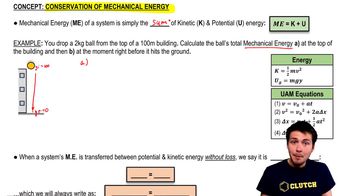
Energy conservation in physics states that energy cannot be created or destroyed, only transformed. In the context of the flea's jump, the kinetic energy at the start is converted into potential energy at the peak height. This principle helps relate the initial speed to the maximum height reached by the flea.
Recommended video:
Guided course
06:24
Conservation Of Mechanical Energy
Related Practice
Textbook Question

If a flea can jump straight up to a height of 0.4400.440 m, How long is it in the air?

1
views
Textbook Question

A small rock is thrown vertically upward with a speed of 22.022.0 m/s from the edge of the roof of a 30.030.0-m-tall building. The rock doesn't hit the building on its way back down and lands on the street below. Ignore air resistance. What is the speed of the rock just before it hits the street?

1
views
Textbook Question

A small rock is thrown vertically upward with a speed of 22.022.0 m/s from the edge of the roof of a 30.030.0-m-tall building. The rock doesn't hit the building on its way back down and lands on the street below. Ignore air resistance. How much time elapses from when the rock is thrown until it hits the street?

1
views
Textbook Question

A small block has constant acceleration as it slides down a frictionless incline. The block is released from rest at the top of the incline, and its speed after it has traveled 6.806.80 m to the bottom of the incline is 3.803.80 m/s. What is the speed of the block when it is 3.403.40 m from the top of the incline?

1
views
Textbook Question

At the instant the traffic light turns green, a car that has been waiting at an intersection starts ahead with a constant acceleration of 2.802.80 m/s2. At the same instant a truck, traveling with a constant speed of 20.020.0 m/s, overtakes and passes the car. How fast is the car traveling when it overtakes the truck?

2
views
Textbook Question

At the instant the traffic light turns green, a car that has been waiting at an intersection starts ahead with a constant acceleration of 2.802.80 m/s2. At the same instant a truck, traveling with a constant speed of 20.020.0 m/s, overtakes and passes the car. How far beyond its starting point does the car overtake the truck?

2
views