Ch 02: Motion Along a Straight Line
Young & Freedman Calc - University Physics 14th Edition
Young & Freedman Calc14th EditionUniversity PhysicsISBN: 9780321973610Not the one you use?Change textbook
Chapter 2, Problem 42a

A brick is dropped (zero initial speed) from the roof of a building. The brick strikes the ground in 1.901.90 s. You may ignore air resistance, so the brick is in free fall. How tall, in meters, is the building?

Verified step by step guidance
1
Identify the known values: The initial velocity (v₀) is 0 m/s, the time (t) is 1.90 s, and the acceleration due to gravity (g) is approximately 9.81 m/s².
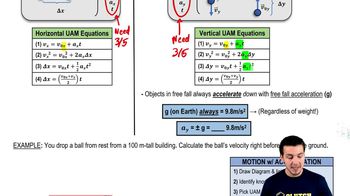
Use the kinematic equation for displacement in free fall: d=v0t+12gt^2. Since the initial velocity is zero, the equation simplifies to d=12gt^2.
Substitute the known values into the simplified equation: d=12(9.81)(1.90)^2.
Calculate the expression inside the parentheses: First, square the time, 1.90^2, then multiply by the acceleration due to gravity, 9.81.
Multiply the result by 12 to find the displacement, which is the height of the building.

Verified video answer for a similar problem:

This video solution was recommended by our tutors as helpful for the problem above.
Video duration:
2m
Was this helpful?

Key Concepts

Here are the essential concepts you must grasp in order to answer the question correctly.

Free Fall

Free fall refers to the motion of an object under the influence of gravitational force only, with no other forces acting on it, such as air resistance. In this scenario, the brick is in free fall, meaning it accelerates downward at a constant rate due to gravity, which is approximately 9.81 m/s² on Earth.
Recommended video:
Guided course
08:36
Vertical Motion & Free Fall

Acceleration Due to Gravity

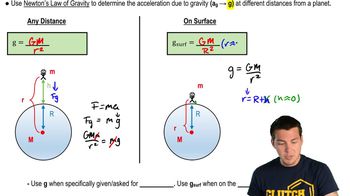
Acceleration due to gravity is the rate at which an object speeds up as it falls freely towards the Earth. It is denoted by 'g' and has a standard value of 9.81 m/s². This constant acceleration is crucial for calculating the distance an object falls over a given time when air resistance is negligible.
Recommended video:
Guided course
05:20
Acceleration Due to Gravity

Kinematic Equations

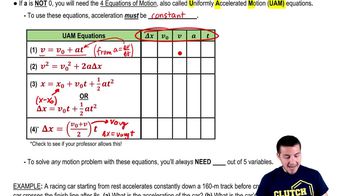
Kinematic equations describe the motion of objects under constant acceleration. For free fall, the equation h = 0.5 * g * t² can be used to find the height from which an object is dropped, where 'h' is the height, 'g' is the acceleration due to gravity, and 't' is the time taken to reach the ground.
Recommended video:
Guided course
08:25
Kinematics Equations
Related Practice
Textbook Question

A tennis ball on Mars, where the acceleration due to gravity is 0.379g0.379g and air resistance is negligible, is hit directly upward and returns to the same level 8.58.5 s later. How high above its original point did the ball go?

2
views
Textbook Question

A 75007500-kg rocket blasts off vertically from the launch pad with a constant upward acceleration of 2.252.25 m/s2 and feels no appreciable air resistance. When it has reached a height of 525525 m, its engines suddenly fail; the only force acting on it is now gravity. What is the maximum height this rocket will reach above the launch pad?

2
views
Textbook Question

A 75007500-kg rocket blasts off vertically from the launch pad with a constant upward acceleration of 2.252.25 m/s2 and feels no appreciable air resistance. When it has reached a height of 525525 m, its engines suddenly fail; the only force acting on it is now gravity. How much time will elapse after engine failure before the rocket comes crashing down to the launch pad, and how fast will it be moving just before it crashes?

2
views
Textbook Question

A lunar lander is making its descent to Moon Base I (Fig. E2.402.40). The lander descends slowly under the retro-thrust of its descent engine. The engine is cut off when the lander is 5.05.0 m above the surface and has a downward speed of 0.80.8 m/s. With the engine off, the lander is in free fall. What is the speed of the lander just before it touches the surface? The acceleration due to gravity on the moon is 1.61.6 m/s.

3
views
Textbook Question

A brick is dropped (zero initial speed) from the roof of a building. The brick strikes the ground in 1.901.90 s. You may ignore air resistance, so the brick is in free fall. What is the magnitude of the brick's velocity just before it reaches the ground?

Textbook Question

A tennis ball on Mars, where the acceleration due to gravity is 0.379g0.379g and air resistance is negligible, is hit directly upward and returns to the same level 8.58.5 s later. How fast was it moving just after it was hit?

2
views