Ch 01: Units, Physical Quantities & Vectors
Young & Freedman Calc - University Physics 14th Edition
Young & Freedman Calc14th EditionUniversity PhysicsISBN: 9780321973610Not the one you use?Change textbook
Chapter 1, Problem 48b

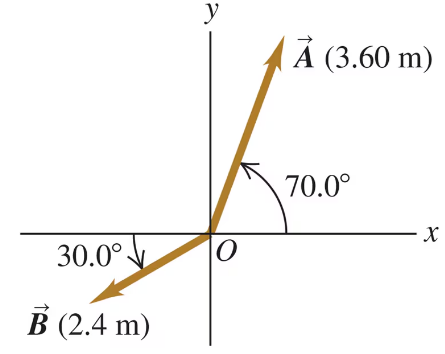
For the two vectors A\(\overrightarrow{A}\) and B\(\overrightarrow{B}\) in the figure1.391.39, find the magnitude and direction of the vector product A×B\(\overrightarrow{A}\[\times\]\overrightarrow{B}\).
Vectors A (3.60 m) and B (2.4 m) at angles 70° and 30° from x-axis, respectively, on a coordinate plane.

Verified step by step guidance
1
Identify the components of vectors A and B. Vector A has a magnitude of 3.2 m and is directed at an angle of 28° below the negative x-axis. Vector B has a magnitude of 4.2 m and is directed at an angle of 52° above the positive x-axis.
Calculate the components of vector A. The x-component of A is A_x = 3.2 * cos(28°) and the y-component is A_y = 3.2 * sin(28°). Since A is directed below the x-axis, A_y will be negative.
Calculate the components of vector B. The x-component of B is B_x = 4.2 * cos(52°) and the y-component is B_y = 4.2 * sin(52°).
Use the formula for the vector product (cross product) A x B = |A| * |B| * sin(θ) * n, where θ is the angle between A and B, and n is the unit vector perpendicular to the plane containing A and B. The angle θ can be found by adding the angles of A and B with respect to the x-axis, which is 28° + 52° = 80°.
Calculate the magnitude of the cross product using the formula |A x B| = |A| * |B| * sin(80°). The direction of the cross product is determined by the right-hand rule, which will be perpendicular to the plane containing A and B.

Verified video answer for a similar problem:

This video solution was recommended by our tutors as helpful for the problem above.
Video duration:
4m
Was this helpful?

Key Concepts

Here are the essential concepts you must grasp in order to answer the question correctly.

Vector Product (Cross Product)

The vector product, or cross product, of two vectors results in a third vector that is perpendicular to the plane containing the original vectors. Its magnitude is given by |A x B| = |A||B|sin(θ), where θ is the angle between vectors A and B. The direction follows the right-hand rule, which helps determine the orientation of the resulting vector.
Recommended video:
Guided course
10:30
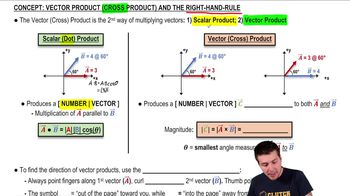
Vector (Cross) Product and the Right-Hand-Rule

Magnitude of a Vector

The magnitude of a vector is a measure of its length and is calculated using the Pythagorean theorem in a Cartesian plane. For a vector with components (x, y), the magnitude is √(x² + y²). In the context of the cross product, the magnitude of the resulting vector depends on the sine of the angle between the original vectors and their individual magnitudes.
Recommended video:
Guided course
03:59
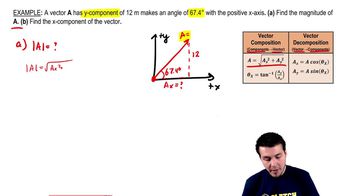
Calculating Magnitude & Components of a Vector

Direction of a Vector

The direction of a vector is defined by the angle it makes with a reference axis, typically the x-axis in a Cartesian coordinate system. For the cross product, the direction is perpendicular to the plane formed by the two vectors, determined by the right-hand rule. This concept is crucial for understanding how the cross product vector is oriented in space.
Recommended video:
Guided course
06:44
Adding 3 Vectors in Unit Vector Notation