A sample of 1.0 x 10¹⁰ atoms that decay by alpha emission has a half-life of 100 min. How many alpha particles are emitted between t = 50 min and t = 200 min?

Ch 42: Nuclear Physics
Knight Calc5th EditionPhysics for Scientists and EngineersISBN: 9780137344796Not the one you use?Change textbook
Chapter 42, Problem 25
The radioactive isotope 230Th has a density of 11,700 kg/m3 and a half-life of 75,000 yr. What is the radius of a 230Th sphere that has an activity of 1.0 Ci?
Verified step by step guidance1
Step 1: Understand the relationship between activity, number of nuclei, and decay constant. Activity (A) is given by \( A = \lambda N \), where \( \lambda \) is the decay constant and \( N \) is the number of radioactive nuclei. The decay constant \( \lambda \) can be calculated using the half-life \( T_{1/2} \) with the formula \( \lambda = \frac{\ln(2)}{T_{1/2}} \).
Step 2: Convert the given activity from curies (Ci) to becquerels (Bq). Recall that \( 1 \, \text{Ci} = 3.7 \times 10^{10} \, \text{Bq} \). Use this conversion to express the activity in SI units.
Step 3: Calculate the number of nuclei \( N \) using the formula \( N = \frac{A}{\lambda} \). Substitute the values for \( A \) (in Bq) and \( \lambda \) (calculated from the half-life).
Step 4: Relate the number of nuclei \( N \) to the mass of the sphere. The number of nuclei \( N \) is given by \( N = \frac{m}{M} \times N_A \), where \( m \) is the mass of the sphere, \( M \) is the molar mass of \( ^{230}Th \) (230 g/mol), and \( N_A \) is Avogadro's number \( 6.022 \times 10^{23} \, \text{mol}^{-1} \). Rearrange this formula to solve for \( m \).
Step 5: Use the density of \( ^{230}Th \) to find the radius of the sphere. The mass \( m \) is related to the volume \( V \) by \( m = \rho V \), where \( \rho \) is the density. The volume of a sphere is \( V = \frac{4}{3} \pi r^3 \). Substitute \( m \) and \( \rho \) into this formula and solve for the radius \( r \).

Verified video answer for a similar problem:
This video solution was recommended by our tutors as helpful for the problem above.
Was this helpful?
Key Concepts
Here are the essential concepts you must grasp in order to answer the question correctly.
Radioactive Decay
Radioactive decay is the process by which an unstable atomic nucleus loses energy by emitting radiation. This decay occurs at a predictable rate characterized by the half-life, which is the time required for half of the radioactive atoms in a sample to decay. Understanding this concept is crucial for calculating the activity of a radioactive substance.
Recommended video:
Guided course
Amplitude Decay in an LRC Circuit
Activity of a Radioactive Sample
The activity of a radioactive sample refers to the number of decays per unit time, typically measured in curies (Ci) or becquerels (Bq). One curie is defined as 3.7 x 10^10 disintegrations per second. This concept is essential for determining how much of a radioactive substance is present and how it relates to the mass and volume of the material.
Recommended video:
Guided course
Phase Diagrams
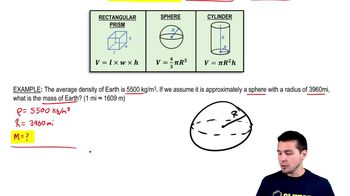
Volume and Density Relationship
The relationship between volume, mass, and density is described by the formula density = mass/volume. In the context of a sphere, the volume can be calculated using the formula V = (4/3)πr³, where r is the radius. This relationship is important for determining the radius of the sphere based on its mass, which can be derived from the activity and density of the radioactive isotope.
Recommended video:
Guided course
Problems with Mass, Volume, & Density
Related Practice
Textbook Question
Textbook Question
Draw energy-level diagrams, similar to Figure 42.11, for all A = 14 nuclei listed in Appendix C. Show all the occupied neutron and proton levels.
6
views
Textbook Question
A Geiger counter is used to measure the decay of a radioactive isotope produced in a nuclear reactor. Initially, when the sample is first removed from the reactor, the Geiger counter registers 15,000 decays/s. 15 h later the count is down to 5500 decays/s. At what time after the sample's removal from the reactor is the count 1200 decays/s?
Textbook Question
Identify the unknown isotope in the following decays.
1
views
Textbook Question
For those that are not stable, identify both the decay mode and the daughter nucleus.
Textbook Question
Identify the unknown isotope in the following decays.
3
views