Ch 40: One-Dimensional Quantum Mechanics
Knight Calc - Physics for Scientists and Engineers 5th Edition
Knight Calc5th EditionPhysics for Scientists and EngineersISBN: 9780137344796Not the one you use?Change textbook
Chapter 40, Problem 15a

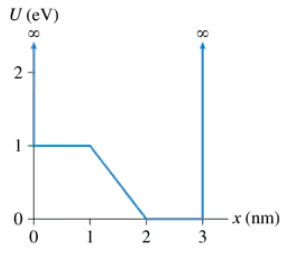
The graph in FIGURE EX40.15 shows the potential-energy function U(x) of a particle. Solution of the Schrödinger equation finds that the n = 3 level has E3 = 0.5 eV and that the n = 6 level has E6 = 2.0 eV. Redraw this figure and add to it the energy lines for the n = 3 and n = 6 states.

Verified step by step guidance
1
Step 1: Understand the problem. The graph provided shows the potential-energy function U(x) of a particle. The task is to redraw the graph and add horizontal lines representing the energy levels for n=3 (E₃ = 0.5 eV) and n=6 (E₆ = 2.0 eV). These energy levels correspond to the solutions of the Schrödinger equation.
Step 2: Identify the axes of the graph. Typically, the x-axis represents the position (x), and the y-axis represents the potential energy U(x). Ensure you understand the shape of the potential-energy curve provided in the figure.
Step 3: Draw the potential-energy curve U(x) as shown in the original figure. Carefully replicate the curve's features, such as peaks, valleys, or flat regions, to ensure accuracy.
Step 4: Add horizontal lines to represent the energy levels. For n=3, draw a horizontal line at E₃ = 0.5 eV. For n=6, draw another horizontal line at E₆ = 2.0 eV. These lines should be parallel to the x-axis and positioned at the corresponding energy values on the y-axis.
Step 5: Label the energy levels on the graph. Clearly mark the lines as 'n=3, E₃ = 0.5 eV' and 'n=6, E₆ = 2.0 eV' to indicate their significance. Ensure the graph is neat and all elements are properly labeled for clarity.

Verified video answer for a similar problem:

This video solution was recommended by our tutors as helpful for the problem above.
Was this helpful?

Key Concepts

Here are the essential concepts you must grasp in order to answer the question correctly.

Potential Energy Function

The potential energy function U(x) describes how the potential energy of a particle varies with its position x. In quantum mechanics, this function is crucial for determining the behavior of particles in a potential well, influencing their allowed energy levels and wave functions. Understanding the shape of U(x) helps visualize how particles can be confined or allowed to move freely within certain regions.
Recommended video:
Guided course
07:24
Potential Energy Graphs

Schrödinger Equation

The Schrödinger equation is a fundamental equation in quantum mechanics that describes how the quantum state of a physical system changes over time. It allows for the calculation of wave functions, which provide information about the probability of finding a particle in a particular state or position. The solutions to this equation yield quantized energy levels, such as E₃ and E₆ in the question, which correspond to specific states of the system.
Recommended video:
Guided course
08:25
Kinematics Equations

Quantum Energy Levels

Quantum energy levels refer to the discrete energy states that a quantum system, such as an electron in an atom, can occupy. These levels arise from the quantization of energy due to boundary conditions imposed by the potential energy function. In the context of the question, E₃ and E₆ represent the energy values for the n=3 and n=6 states, respectively, indicating that the particle can only exist at these specific energy levels within the potential well.
Recommended video:
Guided course
04:10
Intro to Energy & Types of Energy