
Ch 40: One-Dimensional Quantum Mechanics
Knight Calc - Physics for Scientists and Engineers 5th Edition
Knight Calc5th EditionPhysics for Scientists and EngineersISBN: 9780137344796Not the one you use?Change textbook
Chapter 40, Problem 29b

INT Model an atom as an electron in a rigid box of length 0.100 nm, roughly twice the Bohr radius. Calculate all the wavelengths that would be seen in the emission spectrum of this atom due to quantum jumps between these four energy levels. Give each wavelength a label λn→m to indicate the transition.

Verified step by step guidance
1
Step 1: Understand the problem. The atom is modeled as an electron in a one-dimensional rigid box (also called an infinite potential well) of length L = 0.100 nm. The energy levels of the electron are quantized, and the emission spectrum corresponds to the wavelengths of photons emitted when the electron transitions between these energy levels.
Step 2: Write the formula for the energy levels of an electron in a rigid box. The energy levels are given by: En = (n2h2)/(8mL2), where n is the quantum number (n = 1, 2, 3, ...), h is Planck's constant, m is the mass of the electron, and L is the length of the box.
Step 3: Calculate the energy difference between two levels n and m (where n > m). The energy difference is: ΔE = En - Em = (h2/(8mL2))(n2 - m2). This energy difference corresponds to the energy of the emitted photon during the transition.
Step 4: Relate the energy of the emitted photon to its wavelength. Use the formula: λ = hc/ΔE, where h is Planck's constant, c is the speed of light, and ΔE is the energy difference calculated in the previous step. Label each wavelength as λn→m to indicate the transition.
Step 5: Calculate the wavelengths for all possible transitions between the first four energy levels (n = 1, 2, 3, 4). For example, calculate λ2→1, λ3→1, λ3→2, λ4→1, λ4→2, and λ4→3. Substitute the values of h, c, m, and L into the formulas to compute the wavelengths.

Verified video answer for a similar problem:

This video solution was recommended by our tutors as helpful for the problem above.
Was this helpful?

Key Concepts

Here are the essential concepts you must grasp in order to answer the question correctly.

Quantum Mechanics

Quantum mechanics is the branch of physics that deals with the behavior of particles at the atomic and subatomic levels. It introduces the concept of quantization, where energy levels are discrete rather than continuous. This framework is essential for understanding how electrons occupy specific energy states in an atom and how they transition between these states, emitting or absorbing photons in the process.
Recommended video:
Guided course
06:24
Conservation Of Mechanical Energy

Particle in a Box Model

The particle in a box model is a fundamental quantum mechanics concept that simplifies the behavior of a particle confined in a rigid, one-dimensional space. In this model, the allowed energy levels of the particle are quantized, leading to specific wavelengths of emitted light when the particle transitions between these levels. This model is particularly useful for visualizing the behavior of electrons in atoms and calculating their energy states.
Recommended video:
Guided course
04:27
Power of Pushing a Box

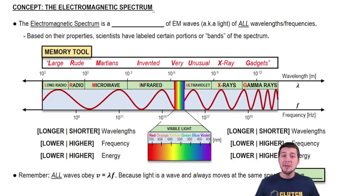
Emission Spectrum

An emission spectrum is the spectrum of light emitted by a substance when its electrons transition from higher to lower energy levels. Each transition corresponds to a specific wavelength of light, which can be calculated using the energy difference between the levels involved. The resulting wavelengths are characteristic of the atom and can be labeled as λn→m, indicating the transition from energy level n to m, providing insight into the atom's electronic structure.
Recommended video:
Guided course
06:06
The Electromagnetic Spectrum