An experiment has four possible outcomes, labeled A to D. The probability of A is PA = 40% and of B is PB = 30%. Outcome C is twice as probable as outcome D. What are the probabilities PC and PD?
Ch 39: Wave Functions and Uncertainty
Knight Calc5th EditionPhysics for Scientists and EngineersISBN: 9780137344796Not the one you use?Change textbook
Chapter 39, Problem 8
In one experiment, 2000 photons are detected in a 0.10-mm-wide strip where the amplitude of the electromagnetic wave is 10 V/m. How many photons are detected in a nearby 0.10-mm-wide strip where the amplitude is 30 V/m?
Verified step by step guidance1
Understand that the number of photons detected is proportional to the intensity of the electromagnetic wave, and the intensity is proportional to the square of the amplitude of the wave. This means \( I \propto A^2 \), where \( I \) is the intensity and \( A \) is the amplitude.
Write the relationship between the number of photons detected \( N \) and the amplitude \( A \): \( N \propto A^2 \). This implies \( \frac{N_2}{N_1} = \frac{A_2^2}{A_1^2} \), where \( N_1 \) and \( N_2 \) are the number of photons detected in the first and second strips, and \( A_1 \) and \( A_2 \) are their respective amplitudes.
Substitute the given values for \( A_1 \) and \( A_2 \): \( A_1 = 10 \, \text{V/m} \) and \( A_2 = 30 \, \text{V/m} \). The equation becomes \( \frac{N_2}{N_1} = \frac{(30)^2}{(10)^2} \).
Simplify the ratio: \( \frac{N_2}{N_1} = \frac{900}{100} = 9 \). This means the number of photons detected in the second strip is 9 times the number detected in the first strip.
Multiply the number of photons detected in the first strip by this ratio to find \( N_2 \): \( N_2 = 9 \times 2000 \). This gives the number of photons detected in the second strip.

Verified video answer for a similar problem:
This video solution was recommended by our tutors as helpful for the problem above.
Was this helpful?
Key Concepts
Here are the essential concepts you must grasp in order to answer the question correctly.
Photon Detection
Photon detection refers to the process of identifying and counting individual photons, which are the fundamental particles of light. The number of detected photons can be influenced by factors such as the intensity of the light source and the area over which the detection occurs. In this context, the experiment measures how varying the amplitude of the electromagnetic wave affects the number of photons detected in a specified area.
Recommended video:
Guided course
Example 2
Amplitude of Electromagnetic Waves
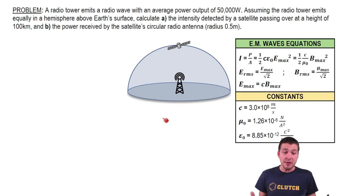
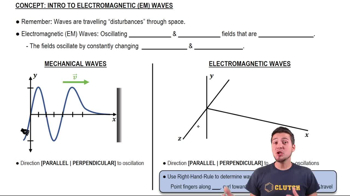
The amplitude of an electromagnetic wave is a measure of the maximum electric field strength of the wave. It is directly related to the intensity of the wave, which is proportional to the square of the amplitude. Higher amplitude indicates a stronger wave, which can lead to a greater number of photons being emitted or detected, as seen in the comparison between the two strips in the experiment.
Recommended video:
Guided course
Introduction to Electromagnetic (EM) Waves
Intensity and Photon Flux
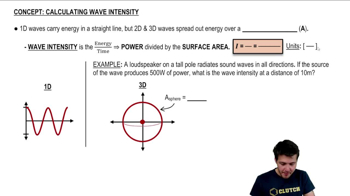
Intensity in the context of electromagnetic waves is defined as the power per unit area and is proportional to the square of the amplitude. Photon flux, which is the number of photons passing through a unit area per unit time, increases with higher intensity. Therefore, by understanding the relationship between intensity, amplitude, and photon detection, one can calculate the expected number of photons detected in different conditions.
Recommended video:
Guided course
Wave Intensity
Related Practice
Textbook Question
1
views
Textbook Question
FIGURE EX39.13 shows the probability density for an electron that has passed through an experimental apparatus. What is the probability that the electron will land in a 0.010-mm-wide strip at x = 0.000 mm?
Textbook Question
When 5×10¹² photons pass through an experimental apparatus, 2.0×10⁹ land in a 0.10-mm-wide strip. What is the probability density at this point?
Textbook Question
FIGURE EX39.12 shows the probability density for an electron that has passed through an experimental apparatus. If 1.0×10⁶ electrons are used, what is the expected number that will land in a 0.010-mm-wide strip at 2.000 mm?