
Ch 38: Quantization
Knight Calc - Physics for Scientists and Engineers 5th Edition
Knight Calc5th EditionPhysics for Scientists and EngineersISBN: 9780137344796Not the one you use?Change textbook
Chapter 38, Problem 68b

INT A beam of electrons is incident upon a gas of hydrogen atoms. Through what potential difference must the electrons be accelerated to have this speed?

Verified step by step guidance
1
Step 1: Understand the problem. The electrons are accelerated through a potential difference, gaining kinetic energy. The goal is to determine the potential difference required for the electrons to reach a specific speed. The relationship between the kinetic energy of the electrons and the potential difference is given by the equation: Ke = qV, where Ke is the kinetic energy, q is the charge of the electron, and V is the potential difference.
Step 2: Relate the kinetic energy to the speed of the electrons. The kinetic energy of the electrons is given by the formula: Ke = (1/2)mv^2, where m is the mass of the electron and v is the speed of the electron.
Step 3: Combine the two equations. Since the kinetic energy gained by the electron is equal to the energy provided by the potential difference, set Ke = qV equal to Ke = (1/2)mv^2. This gives: qV = (1/2)mv^2.
Step 4: Solve for the potential difference V. Rearrange the equation to isolate V: V = (mv^2)/(2q). Here, m is the mass of the electron, v is the speed of the electron, and q is the charge of the electron.
Step 5: Substitute known values into the equation. Use the mass of the electron (m = 9.11 × 10⁻³¹ kg), the charge of the electron (q = 1.60 × 10⁻¹⁹ C), and the given speed of the electron (v) to calculate the potential difference V. Ensure all units are consistent.

Verified video answer for a similar problem:

This video solution was recommended by our tutors as helpful for the problem above.
Was this helpful?

Key Concepts

Here are the essential concepts you must grasp in order to answer the question correctly.

Kinetic Energy and Potential Difference

The kinetic energy of an electron can be expressed as KE = (1/2)mv², where m is the mass and v is the velocity of the electron. When electrons are accelerated through a potential difference (V), they gain kinetic energy equal to the work done on them, given by KE = eV, where e is the charge of the electron. Thus, to find the potential difference required to achieve a certain speed, one can rearrange the equation to V = (1/2)mv²/e.
Recommended video:
Guided course
07:24
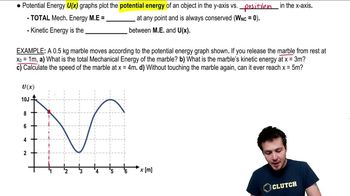
Potential Energy Graphs

Charge of an Electron

The charge of an electron is a fundamental physical constant, approximately equal to -1.602 x 10^-19 coulombs. This negative charge is crucial in calculations involving electric fields and potential differences, as it determines the direction of force experienced by the electron in an electric field. Understanding the charge allows for accurate calculations of energy changes when electrons are accelerated.
Recommended video:
Guided course
04:32
Electrons In Water (Using Density)

Acceleration of Charged Particles

When charged particles like electrons move through an electric field, they experience a force that causes them to accelerate. The relationship between the force (F), charge (q), and electric field (E) is given by F = qE. This acceleration is what allows electrons to gain speed as they traverse a potential difference, making it essential to understand how electric fields influence the motion of charged particles in physics.
Recommended video:
Guided course
06:36
Charging Objects
Related Practice
Textbook Question

In the atom interferometer experiment of Figure 38.13, laser-cooling techniques were used to cool a dilute vapor of sodium atoms to a temperature of 0.0010 K=1.0 mK. The ultracold atoms passed through a series of collimating apertures to form the atomic beam you see entering the figure from the left. The standing light waves were created from a laser beam with a wavelength of 590 nm. Because interference is observed between the two paths, each individual atom is apparently present at both point B and point C. Describe, in your own words, what this experiment tells you about the nature of matter.

2
views
Textbook Question

Very large, hot stars—much hotter than our sun—can be identified by the way in which He+ ions in their atmosphere absorb light. What are the three longest wavelengths, in nm, in the Balmer series of He+?

1
views
Textbook Question

INT A beam of electrons is incident upon a gas of hydrogen atoms. What minimum speed must the electrons have to cause the emission of 656 nm light from the 3→2 transition of hydrogen?

1
views
Textbook Question

The electrons in a cathode-ray tube are accelerated through a 250 V potential difference and then shot through a 33-nm-diameter circular aperture. What is the diameter of the bright spot on an electron detector 1.5 m behind the aperture?

1
views
Textbook Question

INT Two hydrogen atoms collide head-on. The collision brings both atoms to a halt. Immediately after the collision, both atoms emit a 121.6 nm photon. What was the speed of each atom just before the collision?

1
views
Textbook Question

Consider an electron undergoing cyclotron motion in a magnetic field. According to Bohr, the electron’s angular momentum must be quantized in units of ℏ. Compute the first four allowed radii in a 1.0 T magnetic field.

2
views