
Ch 37: The Foundations of Modern Physics
Knight Calc - Physics for Scientists and Engineers 5th Edition
Knight Calc5th EditionPhysics for Scientists and EngineersISBN: 9780137344796Not the one you use?Change textbook
Chapter 37, Problem 36

In one of Thomson’s experiments he placed a thin metal foil in the electron beam and measured its temperature rise. Consider a cathode-ray tube in which electrons are accelerated through a 2000 V potential difference, then strike a 10 mg copper foil. What is the electron-beam current if the foil temperature rises 6.0°C in 10 s? Assume no loss of energy by radiation or other means. The specific heat of copper is 385 J/kg K .

Verified step by step guidance
1
Step 1: Calculate the energy gained by each electron as it is accelerated through the potential difference. The energy is given by the equation: E=qV, where q is the charge of an electron (1.6 × 10⁻¹⁹ C) and V is the potential difference (2000 V).
Step 2: Determine the total heat energy absorbed by the copper foil using the formula: Q=mcΔT, where m is the mass of the foil (10 mg = 10 × 10⁻³ g = 10⁻⁵ kg), c is the specific heat of copper (385 J/kg·K), and ΔT is the temperature rise (6.0°C).
Step 3: Calculate the total energy delivered by the electron beam in 10 seconds. Since all the energy from the electrons is transferred to the foil, the total energy delivered is equal to the heat energy Q calculated in Step 2.
Step 4: Determine the number of electrons required to deliver this energy. Use the relationship: n=QE, where E is the energy per electron (calculated in Step 1).
Step 5: Calculate the electron-beam current using the formula: I=ntq, where n is the number of electrons (from Step 4), t is the time (10 s), and q is the charge of an electron.

Verified video answer for a similar problem:

This video solution was recommended by our tutors as helpful for the problem above.
Was this helpful?

Key Concepts

Here are the essential concepts you must grasp in order to answer the question correctly.

Electron Beam Current

Electron beam current refers to the flow of electrons through a conductor, measured in amperes (A). In the context of the question, it can be calculated by determining the total energy transferred to the copper foil and relating it to the charge of the electrons that produced that energy. The current is a crucial factor in understanding how much energy is delivered to the foil and how it affects the temperature rise.
Recommended video:
Guided course
13:40
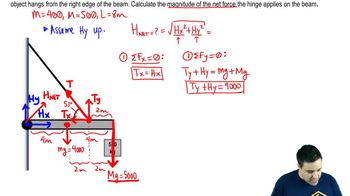
Beam supporting an object

Specific Heat Capacity

Specific heat capacity is the amount of heat required to raise the temperature of a unit mass of a substance by one degree Celsius (or Kelvin). For copper, this value is 385 J/kg K, which indicates how much energy is needed to increase the temperature of the copper foil. This concept is essential for calculating the energy absorbed by the foil and subsequently determining the electron beam current.
Recommended video:
Guided course
06:50
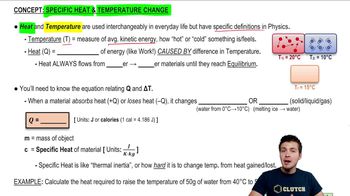
Specific Heat & Temperature Changes

Energy Transfer in Electrical Systems

Energy transfer in electrical systems involves the conversion of electrical energy into other forms, such as thermal energy. In this scenario, the kinetic energy of the accelerated electrons is converted into heat when they collide with the copper foil. Understanding this energy transfer is vital for calculating the temperature change in the foil and linking it to the current of the electron beam.
Recommended video:
Guided course
06:48
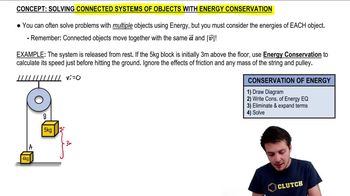
Systems Of Objects with Energy Conservation
Related Practice
Textbook Question

The factor γ appears in many relativistic expressions. A value γ = 1.01 implies that relativity changes the Newtonian values by approximately 1% and that relativistic effects can no longer be ignored. At what kinetic energy, in MeV, is γ = 1.01 for (a) an electron, (b) a proton, and (c) an alpha particle?

2
views
Textbook Question

A ²²²Rn atom (radon) in a 0.75 T magnetic field undergoes radioactive decay, emitting an alpha particle in a direction perpendicular to B\(\overrightarrow{B}\). The alpha particle begins cyclotron motion with a radius of 45 cm. With what energy, in MeV, was the alpha particle emitted?

96
views
1
rank
Textbook Question

The oxygen nucleus ¹⁶O has a radius of 3.0 fm. With what speed must a proton be fired toward an oxygen nucleus to have a turning point 1.0 fm from the surface? Assume the nucleus remains at rest.

2
views
Textbook Question

What is the velocity, as a fraction of c, of an electron with 2.0 GeV total energy? Hint: This problem uses relativity.

1
views
Textbook Question

The fission process n + ²³⁵U → ²³⁶U → ¹⁴⁴Ba + ⁸⁹Kr + 3n converts 0.185 u of mass into the kinetic energy of the fission products. What is the total kinetic energy in MeV?

2
views
Textbook Question

To initiate a nuclear reaction, an experimental nuclear physicist wants to shoot a proton into a 5.50-fm-diameter ¹²C nucleus. The proton must impact the nucleus with a kinetic energy of 3.00 MeV. Assume the nucleus remains at rest. Through what potential difference must the proton be accelerated from rest to acquire this speed?