Ch 35: Optical Instruments
Knight Calc - Physics for Scientists and Engineers 5th Edition
Knight Calc5th EditionPhysics for Scientists and EngineersISBN: 9780137344796Not the one you use?Change textbook
Chapter 35, Problem 41

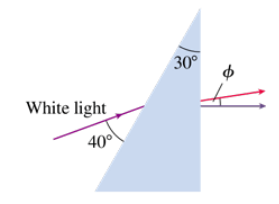
White light is incident onto a 30° prism at the 40° angle shown in FIGURE P35.41. Violet light emerges perpendicular to the rear face of the prism. The index of refraction of violet light in this glass is 2.0% larger than the index of refraction of red light. At what angle Φ does red light emerge from the rear face?

Verified step by step guidance
1
Step 1: Understand the problem setup. White light enters a prism at a given angle, and the prism causes dispersion due to the different indices of refraction for violet and red light. Violet light emerges perpendicular to the rear face, and we need to determine the angle Φ at which red light emerges.
Step 2: Use Snell's Law at the first interface (air to prism) to calculate the angle of refraction for both violet and red light. Snell's Law is given by: n1sinθ=n2sinθ', where n1 is the index of refraction of air (approximately 1), n2 is the index of refraction of the prism for violet or red light, and θ and θ' are the angles of incidence and refraction, respectively.
Step 3: Determine the path of light inside the prism. The light refracts again at the second interface (prism to air). For violet light, it emerges perpendicular to the rear face, meaning its angle of refraction at the second interface is 90°. Use Snell's Law again to calculate the angle of incidence for violet light at the second interface.
Step 4: Apply the geometry of the prism to relate the angles of incidence and refraction for red light at the second interface. The prism's apex angle (30°) and the difference in indices of refraction (2.0% larger for violet light) will affect the path of red light. Use trigonometric relationships to find the angle Φ at which red light emerges.
Step 5: Solve the equations derived from Snell's Law and the prism geometry to find the angle Φ for red light. Ensure that the calculations account for the difference in indices of refraction between violet and red light.

Verified video answer for a similar problem:

This video solution was recommended by our tutors as helpful for the problem above.
Video duration:
10m
Was this helpful?

Key Concepts

Here are the essential concepts you must grasp in order to answer the question correctly.

Refraction

Refraction is the bending of light as it passes from one medium to another due to a change in its speed. This phenomenon is governed by Snell's Law, which relates the angles of incidence and refraction to the indices of refraction of the two media. Understanding refraction is crucial for analyzing how light behaves when it enters and exits the prism.
Recommended video:
Guided course
03:46
Index of Refraction

Index of Refraction

The index of refraction is a dimensionless number that describes how fast light travels in a medium compared to its speed in a vacuum. It is defined as the ratio of the speed of light in vacuum to the speed of light in the medium. In this problem, the difference in indices of refraction for violet and red light is essential for determining the angles at which these colors emerge from the prism.
Recommended video:
Guided course
03:46
Index of Refraction

Prism Geometry

Prism geometry involves understanding the shape and angles of a prism, which affects how light refracts as it enters and exits. The angles of the prism and the angles of incidence and emergence are critical for applying Snell's Law correctly. In this scenario, the specific angles given (30° and 40°) are necessary to calculate the emergence angle for red light based on the known behavior of violet light.
Recommended video:
Guided course
04:33
Problems with Mass, Volume, & Density
Related Practice
Textbook Question

A microscope with a tube length of 180 mm achieves a total magnification of 800x with a 40x objective and a 20x eyepiece. The microscope is focused for viewing with a relaxed eye. Approximately how far is the sample from the objective lens?

1
views
Textbook Question

A simple and relatively inexpensive microscope eyepiece is the Ramsden eyepiece shown in FIGURE P35.40. Two plano-convex lenses have their curved surfaces facing each other, which a more advanced analysis shows is the orientation that minimizes spherical aberration. That same analysis finds that chromatic aberration is minimized with lens spacing L = 1/2 (f₁ + f₂). Your task is to design a 10x Ramsden eyepiece in which the first lens has a focal length of 30 mm. What are (a) the focal length and (b) the spacing of the second lens?

1
views
Textbook Question

The resolution of a digital camera is limited by two factors: diffraction by the lens, a limit of any optical system, and the fact that the sensor is divided into discrete pixels. Consider a typical point-and-shoot camera that has a 20-mm-focal-length lens and a sensor with 2.5μm x 2.5 μm pixels. What is the f-number of the lens for the diameter you found in part b? Your answer is a quite realistic value of the f-number at which a camera transitions from being pixel limited to being diffraction limited. For f-numbers smaller than this (larger-diameter apertures), the resolution is limited by the pixel size and does not change as you change the aperture. For f-numbers larger than this (smaller-diameter apertures), the resolution is limited by diffraction, and it gets worse as you “stop down” to smaller apertures.

1
views
Textbook Question

High-power lasers are used to cut and weld materials by focusing the laser beam to a very small spot. This is like using a magnifying lens to focus the sun's light to a small spot that can burn things. As an engineer, you have designed a laser cutting device in which the material to be cut is placed 5.0 cm behind the lens. You have selected a high-power laser with a wavelength of 1.06 μm. Your calculations indicate that the laser must be focused to a 5.0-μm-diameter spot in order to have sufficient power to make the cut. What is the minimum diameter of the lens you must install?

1
views
Textbook Question

Modern microscopes are more likely to use a camera than human viewing. This is accomplished by replacing the eyepiece in Figure 35.14 with a photo-ocular that focuses the of the objective to a real on the sensor of a digital camera. Suppose the sensor is 22.5 mm wide, a typical value, with 4.0 μm x 4.0 μm pixels. The photo of a cell is 120 pixels in diameter. What is the cell’s actual diameter, in μm?

1
views
Textbook Question

The Hubble Space Telescope has a mirror diameter of 2.4 m. Suppose the telescope is used to photograph stars near the center of our galaxy, 30,000 light years away, using red light with a wavelength of 650 nm. For comparison, what is this distance as a multiple of the distance of Jupiter from the sun?

2
views