Ch 34: Ray Optics
Knight Calc - Physics for Scientists and Engineers 5th Edition
Knight Calc5th EditionPhysics for Scientists and EngineersISBN: 9780137344796Not the one you use?Change textbook
Chapter 34, Problem 34

A laser beam in air is incident on a liquid at an angle of 53° with respect to the normal. The laser beam's angle in the liquid is 35°. What is the liquid's index of refraction?

Verified step by step guidance
1
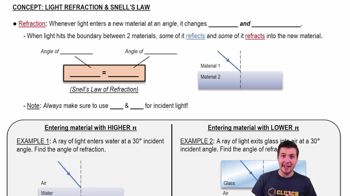
Identify the relevant physics principle: This problem involves Snell's Law, which relates the angles of incidence and refraction to the indices of refraction of two media. The formula is: n1sinθ1=n2sinθ2, where n1 and n2 are the indices of refraction of the first and second medium, and θ1 and θ2 are the angles of incidence and refraction, respectively.
Assign known values: The index of refraction of air is approximately n1=1.00. The angle of incidence is θ1=53°, and the angle of refraction in the liquid is θ2=35°. The goal is to find the liquid's index of refraction, n2.
Rearrange Snell's Law to solve for the unknown index of refraction: n2=n1sinθ1sinθ2.
Substitute the known values into the equation: n2=1.00sin53°sin35°.
Use a scientific calculator to compute the sine values for the angles and divide them to find n2. Ensure your calculator is in degree mode when calculating the sine of the angles.

Verified video answer for a similar problem:

This video solution was recommended by our tutors as helpful for the problem above.
Was this helpful?

Key Concepts

Here are the essential concepts you must grasp in order to answer the question correctly.

Snell's Law

Snell's Law describes the relationship between the angles of incidence and refraction when a wave passes between two different media. It is mathematically expressed as n1 * sin(θ1) = n2 * sin(θ2), where n1 and n2 are the indices of refraction of the two media, and θ1 and θ2 are the angles of incidence and refraction, respectively. This law is fundamental in understanding how light behaves at the interface of different materials.
Recommended video:

Index of Refraction

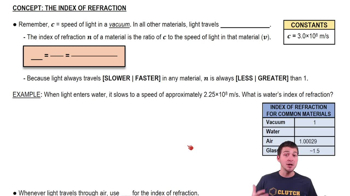
The index of refraction (n) is a dimensionless number that describes how fast light travels in a medium compared to its speed in a vacuum. It is defined as n = c/v, where c is the speed of light in a vacuum and v is the speed of light in the medium. A higher index indicates that light travels slower in that medium, which affects how light bends when entering or exiting the material.
Recommended video:
Guided course
03:46
Index of Refraction

Angle of Incidence and Refraction

The angle of incidence is the angle between the incident ray and the normal line at the point of contact on the surface, while the angle of refraction is the angle between the refracted ray and the normal. These angles are crucial for applying Snell's Law to determine how light changes direction when transitioning between different media, such as air and liquid in this scenario.
Recommended video:
Guided course
03:46
Index of Refraction