

Ch 34: Ray Optics
Knight Calc - Physics for Scientists and Engineers 5th Edition
Knight Calc5th EditionPhysics for Scientists and EngineersISBN: 9780137344796Not the one you use?Change textbook
Chapter 34, Problem 52

A 4.0-m-wide swimming pool is filled to the top. The bottom of the pool becomes completely shaded in the afternoon when the sun is 20° above the horizon. How deep is the pool?

Verified step by step guidance
1
Step 1: Understand the problem. The pool is filled with water, and the bottom becomes shaded when the sun is at an angle of 20° above the horizon. This indicates that the sunlight is refracted at the water's surface. We need to calculate the depth of the pool using the principles of refraction and geometry.
Step 2: Identify the relationship between the angle of incidence (sunlight entering the water) and the angle of refraction (light traveling inside the water). Use Snell's Law: n1sinθ1=n2sinθ2, where n1 is the refractive index of air (approximately 1), n2 is the refractive index of water (approximately 1.33), θ1 is the angle of incidence (20°), and θ2 is the angle of refraction.
Step 3: Calculate the angle of refraction using Snell's Law. Rearrange the formula to solve for θ2: sinθ2=n1sinθ1n2. Substitute the values: n1=1, n2=1.33, and θ1=20°. Compute θ2.
Step 4: Use trigonometry to relate the width of the pool and the depth. The refracted light forms a right triangle where the width of the pool is the base, the depth of the pool is the height, and the angle of refraction is the angle between the base and the hypotenuse. Use the tangent function: tanθ2=depthwidth. Rearrange to solve for depth: depth=widthtanθ2. Substitute the width of the pool (4.0 m) and the calculated angle of refraction.
Step 5: Perform the calculation to find the depth of the pool. Ensure all units are consistent, and verify the result using the principles of refraction and geometry.

Verified video answer for a similar problem:

This video solution was recommended by our tutors as helpful for the problem above.
Video duration:
5m
Was this helpful?

Key Concepts

Here are the essential concepts you must grasp in order to answer the question correctly.

Angle of Incidence

The angle of incidence is the angle formed between the incoming rays of light and a line perpendicular to the surface at the point of incidence. In this scenario, the sun's rays strike the water at an angle of 20° above the horizon, which affects how far the light penetrates into the water and thus determines the depth of the pool that remains illuminated.
Recommended video:
Guided course
01:04
Critical Angle

Refraction of Light

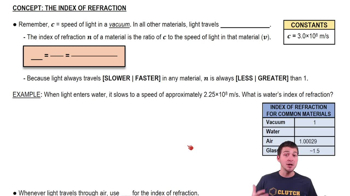
Refraction is the bending of light as it passes from one medium to another, in this case, from air into water. This bending occurs because light travels at different speeds in different media. Understanding refraction is crucial for calculating how deep the pool is, as it influences the angle at which light enters the water and how far it can reach before being absorbed or scattered.
Recommended video:
Guided course
03:46
Index of Refraction

Trigonometric Relationships

Trigonometric relationships, particularly involving right triangles, are essential for solving problems related to angles and distances. In this context, the width of the pool and the angle of the sun can be used to form a right triangle, allowing us to apply trigonometric functions to find the depth of the pool based on the geometry of the situation.
Recommended video:
Guided course
3:26
Trigonometry
Related Practice
Textbook Question

Shown from above in FIGURE P34.54 is one corner of a rectangular box filled with water. A laser beam starts 10 cm from side A of the container and enters the water at position x. You can ignore the thin walls of the container. If x = 15 cm, does the laser beam refract back into the air through side B or reflect from side B back into the water? Determine the angle of refraction or reflection.

1
views
Textbook Question

Shown from above in FIGURE P34.54 is one corner of a rectangular box filled with water. A laser beam starts 10 cm from side A of the container and enters the water at position x. You can ignore the thin walls of the container. Find the minimum value of x for which the laser beam passes through side B and emerges into the air.

2
views
Textbook Question

A light ray in air is incident on a transparent material whose index of refraction is n. Find an expression for the (non-zero) angle of incidence whose angle of refraction is half the angle of incidence.

1
views
Textbook Question

The 80-cm-tall, 65-cm-wide tank shown in FIGURE P34.48 is completely filled with water. The tank has marks every 10 cm along one wall, and the 0 cm mark is barely submerged. As you stand beside the opposite wall, your eye is level with the top of the water. Can you see the marks from the top of the tank (the 0 cm mark) going down, or from the bottom of the tank (the 80 cm mark) coming up? Explain.


1
views
Textbook Question

A horizontal meter stick is centered at the bottom of a 3.0-m-deep, 3.0-m-wide pool of water. Suppose you place your eye just above the edge of the pool and look along the direction of the meter stick. What angle do you observe between the two ends of the meter stick if the pool is (a) empty and (b) completely filled with water?

1
views
Textbook Question

An astronaut is exploring an unknown planet when she accidentally drops an oxygen canister into a 1.50-m-deep pool filled with an unknown liquid. Although she dropped the canister 21 cm from the edge, it appears to be 31 cm away when she peers in from the edge. What is the liquid's index of refraction? Assume that the planet's atmosphere is similar to earth's.

1
views