Ch 32: AC Circuits
Knight Calc - Physics for Scientists and Engineers 5th Edition
Knight Calc5th EditionPhysics for Scientists and EngineersISBN: 9780137344796Not the one you use?Change textbook
Chapter 32, Problem 70a

Show that the peak inductor voltage in a series RLC circuit is maximum at frequency ωL=(1ω0212R2C2)1/2\(\omega\)_L = \(\left\)( \(\frac{1}{\omega_0^2}\) - \(\frac{1}{2}\) R^2 C^2 \(\right\))^{-1/2}.

Verified step by step guidance
1
Start by recalling the resonance condition for a series RLC circuit. The resonance frequency, \( \omega_0 \), is given by \( \omega_0 = \frac{1}{\sqrt{LC}} \). This is the frequency at which the impedance of the circuit is purely resistive, and the reactive components cancel each other out.
The voltage across the inductor, \( V_L \), is given by \( V_L = I \cdot X_L \), where \( I \) is the current in the circuit and \( X_L = \omega L \) is the inductive reactance. The current \( I \) in the circuit is determined by \( I = \frac{V}{Z} \), where \( Z \) is the total impedance of the circuit.
The total impedance \( Z \) of the series RLC circuit is \( Z = \sqrt{R^2 + (X_L - X_C)^2} \), where \( X_C = \frac{1}{\omega C} \) is the capacitive reactance. Substituting \( X_L \) and \( X_C \), \( Z = \sqrt{R^2 + (\omega L - \frac{1}{\omega C})^2} \).
To maximize the voltage across the inductor, \( V_L \), we need to maximize \( X_L \) while minimizing \( Z \). This occurs at a specific frequency \( \omega_L \). By analyzing the derivative of \( V_L \) with respect to \( \omega \) and setting it to zero, we find that the peak inductor voltage occurs at \( \omega_L = \left( \frac{1}{\omega_0^2} - \frac{1}{2} R^2 C^2 \right)^{-1/2} \).
Finally, verify the result by substituting \( \omega_L \) back into the expressions for \( X_L \), \( Z \), and \( V_L \) to confirm that \( V_L \) is indeed maximized at this frequency. This involves algebraic manipulation and simplification to ensure consistency with the given formula.

Verified video answer for a similar problem:

This video solution was recommended by our tutors as helpful for the problem above.
Was this helpful?

Key Concepts

Here are the essential concepts you must grasp in order to answer the question correctly.

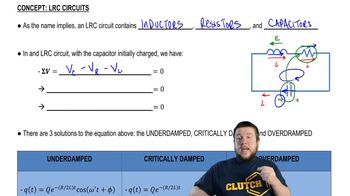
RLC Circuit

An RLC circuit is an electrical circuit consisting of a resistor (R), inductor (L), and capacitor (C) connected in series or parallel. The behavior of the circuit is characterized by its resonant frequency, which is the frequency at which the circuit can oscillate with maximum amplitude. Understanding the dynamics of RLC circuits is crucial for analyzing how voltage and current behave at different frequencies.
Recommended video:

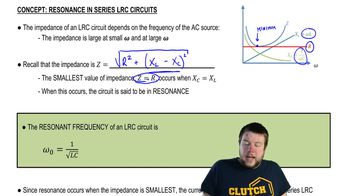
Resonant Frequency

The resonant frequency ( ω_0 ) of an RLC circuit is the frequency at which the inductive and capacitive reactances are equal in magnitude but opposite in phase, resulting in maximum current flow. It is given by the formula ω_0 = 1/ √(LC) . At this frequency, the circuit can store and transfer energy between the inductor and capacitor efficiently, leading to significant voltage peaks.
Recommended video:
Guided course
05:23
Resonance in Series LRC Circuits

Impedance

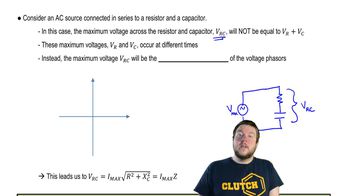
Impedance is the total opposition that a circuit offers to the flow of alternating current (AC) at a given frequency, combining resistance (R) and reactance (X). In RLC circuits, impedance varies with frequency, affecting the voltage across each component. The peak inductor voltage occurs at a specific frequency where the impedance is minimized, allowing for maximum energy transfer and voltage amplification.
Recommended video:
Guided course
08:40
Impedance in AC Circuits