Ch 32: AC Circuits
Knight Calc - Physics for Scientists and Engineers 5th Edition
Knight Calc5th EditionPhysics for Scientists and EngineersISBN: 9780137344796Not the one you use?Change textbook
Chapter 32, Problem 67c

A motor attached to a 120 V/60 Hz power line draws an 8.0 A current. Its average energy dissipation is 800 W. What is the motor's resistance?

Verified step by step guidance
1
Step 1: Start by recalling Ohm's Law, which relates voltage (V), current (I), and resistance (R) as: V = IR. Rearrange this equation to solve for resistance: R = V/I.
Step 2: Identify the given values from the problem: the voltage V = 120 V and the current I = 8.0 A.
Step 3: Substitute the given values into the formula for resistance: R = 1208.0. Perform the division to find the resistance.
Step 4: Verify the calculated resistance by checking if it aligns with the power dissipation formula: P = IR2. Rearrange to solve for R and confirm consistency with the given power P = 800 W.
Step 5: Conclude by ensuring all units are consistent and the resistance value is reasonable for the given motor's operation.

Verified video answer for a similar problem:

This video solution was recommended by our tutors as helpful for the problem above.
Was this helpful?

Key Concepts

Here are the essential concepts you must grasp in order to answer the question correctly.

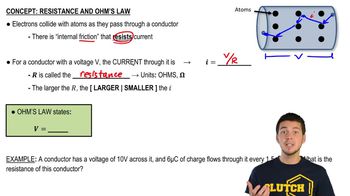
Ohm's Law

Ohm's Law states that the current (I) flowing through a conductor between two points is directly proportional to the voltage (V) across the two points and inversely proportional to the resistance (R) of the conductor. It is mathematically expressed as V = I * R. This relationship is fundamental in electrical circuits, allowing us to calculate resistance when voltage and current are known.
Recommended video:
Guided course
03:07
Resistance and Ohm's Law

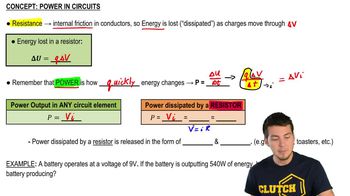
Power in Electrical Circuits

The power (P) consumed by an electrical device is defined as the rate at which it uses energy, calculated using the formula P = V * I, where V is voltage and I is current. In this context, power can also be expressed in terms of resistance using P = I² * R. Understanding this relationship is crucial for analyzing how much energy a device dissipates as heat or performs work.
Recommended video:
Guided course
06:18
Power in Circuits

Resistive Load

A resistive load is an electrical component that consumes power primarily in the form of heat, such as a motor or a resistor. In a resistive load, the current and voltage are in phase, meaning they reach their maximum and minimum values simultaneously. This concept is important for calculating resistance in circuits where the load behaves according to Ohm's Law, allowing for straightforward analysis of energy dissipation.
Recommended video:
Guided course
05:07
Lowering a Load of Bricks
Related Practice
Textbook Question

FIGURE CP32.68 shows voltage and current graphs for a series RLC circuit. What is the resistance R?

1
views

Textbook Question

Prove that the energy dissipation is a maximum at ω = ω₀.

1
views
Textbook Question

A motor attached to a 120 V/60 Hz power line draws an 8.0 A current. Its average energy dissipation is 800 W. What is the rms resistor voltage?

1
views
Textbook Question

Commercial electricity is generated and transmitted as three-phase electricity. Instead of a single emf ε = ε0 cos ωt, three separate wires carry currents for the emfs ε1 = ε0 cos ωt, ε2 = ε0 cos(ωt+120°), and ε3 = ε0 cos(ωt−120°). This is why the long-distance transmission lines you see in the countryside have three parallel wires, as do many distribution lines within a city. Show that the potential difference between any two of the phases has the rms value 3–√ εrms, where εrms is the familiar single-phase rms voltage. Evaluate this potential difference for εrms = 120 V. Some high-power home appliances, especially electric clothes dryers and hot-water heaters, are designed to operate between two of the phases rather than between one phase and neutral. Heavy-duty industrial motors are designed to operate from all three phases, but full three-phase power is rare in residential or office use.

Textbook Question

A motor attached to a 120 V/60 Hz power line draws an 8.0 A current. Its average energy dissipation is 800 W. How much series capacitance needs to be added to increase the power factor to 1.0?

Textbook Question

You're the operator of a 15,000 V rms, 60 Hz electrical substation. When you get to work one day, you see that the station is delivering 6.0 MW of power with a power factor of 0.90. What is the rms current leaving the station?

3
views