
Textbook Question
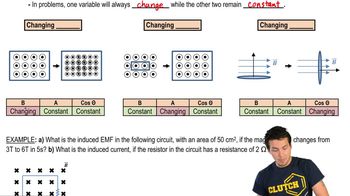
FIGURE EX30.13 shows a 10-cm-diameter loop in three different magnetic fields. The loop's resistance is 0.20 Ω. For each, what are the size and direction of the induced current?

 Verified step by step guidance
 09:26
09:26
 03:07
03:07 04:52
04:52FIGURE EX30.13 shows a 10-cm-diameter loop in three different magnetic fields. The loop's resistance is 0.20 Ω. For each, what are the size and direction of the induced current?
CALC A 5.0-cm-diameter coil has 20 turns and a resistance of 0.50 Ω. A magnetic field perpendicular to the coil is B = 0.020t + 0.010t2, where B is in tesla and t is in seconds. Find an expression for the induced current I(t) as a function of time.
FIGURE EX30.19 shows the current as a function of time through a 20-cm-long, 4.0-cm-diameter solenoid with 400 turns. Draw a graph of the induced electric field strength as a function of time at a point 1.0 cm from the axis of the solenoid.
A 12-cm-diameter, 1.0-m-long solenoid is wound with 2000 turns of superconducting wire. When the magnet is turned on, the current increases from 0 to Imax in 2.5 s. At t = 1.0 s, the induced electric field midway between the axis and the windings is 7.5×10⁻³ V/m. What is the solenoid's steady magnetic field strength?
A 1000-turn coil of wire 1.0 cm in diameter is in a magnetic field that increases from 0.10 T to 0.30 T in 10 ms. The axis of the coil is parallel to the field. What is the emf of the coil?
The magnetic field inside a 5.0-cm-diameter solenoid is 2.0 T and decreasing at 4.0 T/s. What is the electric field strength inside the solenoid at a point (a) on the axis and (b) 2.0 cm from the axis?