
Textbook Question
An antiproton (same properties as a proton except that q = -e) is moving in the combined electric and magnetic fields of FIGURE P29.61. What are the magnitude and direction of the antiproton's acceleration at this instant?

 Verified step by step guidance
 09:08
09:08
 03:48
03:48 01:21
01:21An antiproton (same properties as a proton except that q = -e) is moving in the combined electric and magnetic fields of FIGURE P29.61. What are the magnitude and direction of the antiproton's acceleration at this instant?
FIGURE P29.64 shows a mass spectrometer, an analytical instrument used to identify the various molecules in a sample by measuring their charge-to-mass ratio q/m. The sample is ionized, the positive ions are accelerated (starting from rest) through a potential difference ∆V, and they then enter a region of uniform magnetic field. The field bends the ions into circular trajectories, but after just half a circle they either strike the wall or pass through a small opening to a detector. As the accelerating voltage is slowly increased, different ions reach the detector and are measured. Consider a mass spectrometer with a 200.00 mT magnetic field and an 8.0000 cm spacing between the entrance and exit holes. To five significant figures, what accelerating potential differences ∆V are required to detect the ions (a) O₂⁺ (b) N₂⁺ and (c) CO⁺? See Exercise 29 for atomic masses; the mass of the missing electron is less than 0.001 u and is not relevant at this level of precision. Although N₂⁺ and CO⁺ both have a nominal molecular mass of 28, they are easily distinguished by virtue of their slightly different accelerating voltages. Use the following constants: 1 u = 1.6605 x 10⁻²⁷ kg, e = 1.6022 x 10⁻¹⁹ C.
A 65-cm-diameter cyclotron uses a 500 V oscillating potential difference between the dees. What is the maximum kinetic energy of a proton if the magnetic field strength is 0.75 T?
Controlled fusion is a possible future energy source that would harness the same nuclear fusion reactions that power the sun. The simplest fusion reaction is ²H⁺ + ²H⁺ → ³He⁺⁺ + n + energy, in which nuclei of two deuterium atoms fuse into a nucleus while ejecting a neutron and releasing a substantial amount of energy. Deuterium is not an element but is the name given to 'heavy hydrogen,' in which the nucleus is not simply a proton but a proton and a neutron, with atomic mass 2 u. Two positive deuterium nuclei, which repel each other, can get close enough to fuse only if they have very high speeds. This can be achieved by creating a plasma of ionized deuterium gas at a temperature of 1.0 x 10⁸ K. No material substance can contain a plasma at this temperature, so the idea is to contain the plasma with magnetic fields. Consider the simplest model of using a solenoid to confine the ions to cyclotron motion around the field lines. The plasma ions have a range of speeds, and it's necessary to contain all the ions with speeds up to three times the rms speed at the plasma temperature. What magnetic field strength is needed to keep the fastest ions in 20-cm-diameter cyclotron orbits? The actual magnetic fields are considerably more complex, but your answer is a reasonable estimate of the required field strengths.
Particle accelerators, such as the Large Hadron Collider, use magnetic fields to steer charged particles around a ring. Consider a proton ring with 36 identical bending magnets connected by straight segments. The protons move along a 1.0-m-long circular arc as they pass through each magnet. What magnetic field strength is needed in each magnet to steer protons around the ring with a speed of 2.5 x 10⁷ m/s? Assume that the field is uniform inside the magnet, zero outside.
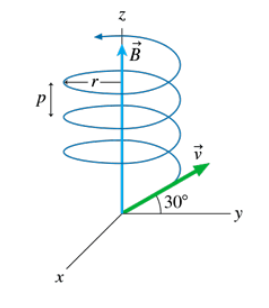
A proton moves in the uniform fields E = 2500 k V/m and B = 0.50 k T. At t = 0 s the proton is moving in a 1.0-cm-diameter circle in the xy-plane. How many revolutions will the proton have made during this time interval?