Ch 29: The Magnetic Field
Knight Calc - Physics for Scientists and Engineers 5th Edition
Knight Calc5th EditionPhysics for Scientists and EngineersISBN: 9780137344796Not the one you use?Change textbook
Chapter 29, Problem 50b

The earth's magnetic field, with a magnetic dipole moment of 8.0 x 10²² A m2, is generated by currents within the molten iron of the earth's outer core. Suppose we model the core current as a 3000-km-diameter current loop made from a 1000-km-diameter 'wire.' The loop diameter is measured from the centers of this very fat wire. What is the current density J in the current loop?

Verified step by step guidance
1
Step 1: Understand the problem. The Earth's magnetic field is modeled as a current loop with a given magnetic dipole moment (\( M = 8.0 \times 10^{22} \; \text{A} \cdot \text{m}^2 \)). The loop has a diameter of 3000 km, and the 'wire' forming the loop has a diameter of 1000 km. We need to calculate the current density \( J \) in the loop, which is defined as the current per unit cross-sectional area of the wire.
Step 2: Relate the magnetic dipole moment to the current in the loop. The magnetic dipole moment of a current loop is given by \( M = I \cdot A \), where \( I \) is the current in the loop and \( A \) is the area enclosed by the loop. The area \( A \) of the loop can be calculated using \( A = \pi r^2 \), where \( r \) is the radius of the loop (half of the diameter).
Step 3: Calculate the cross-sectional area of the 'wire.' The wire forming the loop has a diameter of 1000 km, so its radius is \( r_{\text{wire}} = \frac{1000}{2} \; \text{km} \). The cross-sectional area of the wire is \( A_{\text{wire}} = \pi r_{\text{wire}}^2 \).
Step 4: Express the current density \( J \). The current density is defined as \( J = \frac{I}{A_{\text{wire}}} \), where \( I \) is the current in the loop and \( A_{\text{wire}} \) is the cross-sectional area of the wire. Substitute \( I \) from Step 2 into this expression to find \( J \) in terms of the given quantities.
Step 5: Substitute the known values. Use the given magnetic dipole moment \( M = 8.0 \times 10^{22} \; \text{A} \cdot \text{m}^2 \), the loop diameter (3000 km), and the wire diameter (1000 km) to calculate \( J \). Ensure all units are converted to SI units (meters) before performing the calculations.

Verified video answer for a similar problem:

This video solution was recommended by our tutors as helpful for the problem above.
Was this helpful?

Key Concepts

Here are the essential concepts you must grasp in order to answer the question correctly.

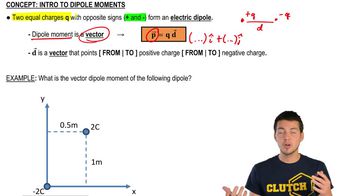
Magnetic Dipole Moment

The magnetic dipole moment is a vector quantity that represents the strength and orientation of a magnetic source. In the context of the Earth's magnetic field, it is generated by the movement of electric charges, specifically the currents in the molten iron of the outer core. The dipole moment is crucial for understanding how the Earth's magnetic field behaves and interacts with external magnetic fields.
Recommended video:
Guided course
03:08
Intro To Dipole Moment

Current Density (J)

Current density (J) is defined as the amount of electric current flowing per unit area of a cross-section. It is expressed in amperes per square meter (A/m²) and provides insight into how concentrated the current is within a conductor. In this problem, calculating the current density involves determining the total current flowing through the loop and dividing it by the cross-sectional area of the 'wire' that forms the loop.
Recommended video:
Guided course
8:13
Intro to Density

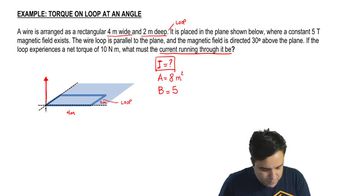
Loop Area and Diameter

The area of a loop is essential for calculating current density and is determined by the formula A = π(d/2)², where d is the diameter of the loop. In this scenario, the loop's diameter is given as 3000 km, which is the distance across the entire loop. Understanding how to calculate the area from the diameter is vital for solving the problem, as it directly influences the current density calculation.
Recommended video:
Guided course
05:03
Torque on a Loop at an Angle