Ch 28: Fundamentals of Circuits
Knight Calc - Physics for Scientists and Engineers 5th Edition
Knight Calc5th EditionPhysics for Scientists and EngineersISBN: 9780137344796Not the one you use?Change textbook
Chapter 28, Problem 34

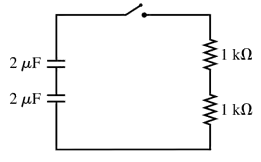
What is the time constant for the discharge of the capacitors in FIGURE EX28.34?
Schematic diagram of a circuit with two 2 µF capacitors and two 1 kΩ resistors.

Verified step by step guidance
1
Identify the formula for the time constant \( \tau \) in an RC circuit, which is given by \( \tau = R \cdot C \), where \( R \) is the equivalent resistance and \( C \) is the capacitance.
Determine the equivalent resistance \( R_{eq} \) of the circuit. If the resistors are in series, add their resistances directly: \( R_{eq} = R_1 + R_2 + \dots \). If they are in parallel, use the formula \( \frac{1}{R_{eq}} = \frac{1}{R_1} + \frac{1}{R_2} + \dots \).
Determine the total capacitance \( C_{eq} \) of the circuit. If the capacitors are in series, use the formula \( \frac{1}{C_{eq}} = \frac{1}{C_1} + \frac{1}{C_2} + \dots \). If they are in parallel, add their capacitances directly: \( C_{eq} = C_1 + C_2 + \dots \).
Substitute the values of \( R_{eq} \) and \( C_{eq} \) into the formula \( \tau = R_{eq} \cdot C_{eq} \) to calculate the time constant.
Verify the units of the time constant \( \tau \). The resistance \( R \) is in ohms (\( \Omega \)) and the capacitance \( C \) is in farads (F), so \( \tau \) will be in seconds (s).

Verified video answer for a similar problem:

This video solution was recommended by our tutors as helpful for the problem above.
Was this helpful?

Key Concepts

Here are the essential concepts you must grasp in order to answer the question correctly.

Capacitance

Capacitance is the ability of a capacitor to store charge per unit voltage. It is measured in farads (F) and is defined by the formula C = Q/V, where C is capacitance, Q is the charge stored, and V is the voltage across the capacitor. Understanding capacitance is essential for analyzing how capacitors behave in circuits, especially during charging and discharging processes.
Recommended video:
Guided course
08:02
Capacitors & Capacitance (Intro)

Time Constant

The time constant, denoted by the symbol τ (tau), is a measure of the time it takes for a capacitor to charge to about 63.2% of the maximum voltage or to discharge to about 36.8% of its initial voltage. It is calculated using the formula τ = RC, where R is the resistance in ohms and C is the capacitance in farads. The time constant is crucial for understanding the speed of the charging and discharging processes in RC circuits.
Recommended video:
Guided course
08:59
Phase Constant of a Wave Function

RC Circuit

An RC circuit is an electrical circuit that consists of a resistor (R) and a capacitor (C) connected in series or parallel. The behavior of the circuit during charging and discharging is governed by the time constant, which influences how quickly the capacitor can store or release energy. Analyzing RC circuits is fundamental in electronics, particularly in timing applications and signal processing.
Recommended video:
Guided course
03:45
Current in a Parallel RC AC Circuit