In FIGURE EX28.30, what is the value of the potential at points 1 and 2?
Ch 28: Fundamentals of Circuits
Knight Calc5th EditionPhysics for Scientists and EngineersISBN: 9780137344796Not the one you use?Change textbook
Chapter 28, Problem 23
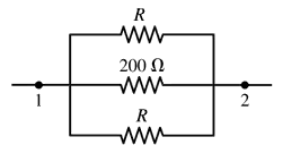
Two of the three resistors in FIGURE EX28.23 are unknown but equal. The total resistance between points 1 and 2 is 75Ω. What is the value of R?

Verified step by step guidance1
Step 1: Analyze the circuit configuration. The circuit consists of three resistors: two resistors with unknown resistance R and one resistor with a resistance of 200Ω. The two resistors R are in parallel with each other, and this parallel combination is in series with the 200Ω resistor.
Step 2: Calculate the equivalent resistance of the two parallel resistors R. The formula for the equivalent resistance of two resistors in parallel is: . Simplify this expression to find the equivalent resistance of the parallel combination.
Step 3: Add the equivalent resistance of the parallel combination to the resistance of the 200Ω resistor, since the parallel combination is in series with the 200Ω resistor. The total resistance of resistors in series is given by: .
Step 4: Set the total resistance equal to the given value of 75Ω. This gives the equation: . Solve this equation for R.
Step 5: Rearrange and simplify the equation to isolate R. Use algebraic manipulation to solve for R, ensuring all terms are correctly handled. This will yield the value of R.

Verified video answer for a similar problem:
This video solution was recommended by our tutors as helpful for the problem above.
Was this helpful?
Key Concepts
Here are the essential concepts you must grasp in order to answer the question correctly.
Ohm's Law
Ohm's Law states that the current (I) flowing through a conductor between two points is directly proportional to the voltage (V) across the two points and inversely proportional to the resistance (R) of the conductor. This relationship is expressed mathematically as V = IR. Understanding this law is crucial for analyzing electrical circuits and calculating unknown values such as current, voltage, or resistance.
Recommended video:
Guided course
Resistance and Ohm's Law
Series and Parallel Resistors
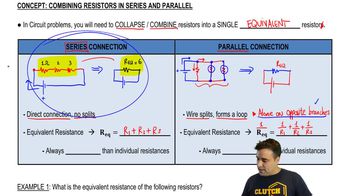
Resistors can be arranged in series or parallel configurations, affecting the total resistance in a circuit. In a series configuration, the total resistance is the sum of individual resistances (R_total = R1 + R2 + ...). In a parallel configuration, the total resistance can be calculated using the formula 1/R_total = 1/R1 + 1/R2 + ... This distinction is essential for solving problems involving multiple resistors, as seen in the given circuit.
Recommended video:
Guided course
Combining Resistors in Series & Parallel
Equivalent Resistance
Equivalent resistance is the total resistance of a circuit that can replace a combination of resistors without changing the current or voltage in the circuit. For resistors in parallel, the equivalent resistance is always less than the smallest individual resistor. In the context of the question, calculating the equivalent resistance between points 1 and 2 is necessary to find the unknown resistor value (R) when the total resistance is given.
Recommended video:
Guided course
Find Equivalent Capacitance #1
Related Practice
Textbook Question
1
views
Textbook Question
Compared to an ideal battery, by what percentage does the battery's internal resistance reduce the potential difference across the 20 Ω resistor in FIGURE EX28.24?
2
views
Textbook Question
What is the equivalent resistance between points 1 and 2 in FIGURE EX28.27?
1
views
Textbook Question
What is the value of resistor R in FIGURE EX28.16?
1
views
Textbook Question
Many electric companies use time-of-day pricing in which electricity costs more during hours of high demand. Suppose electricity costs \(0.21/kWh from 10 a.m. to 6 p.m.; \)0.09/kWh at all other times. What is the annual cost of electricity for a 2.5 kW industrial pump that runs 24 hours a day?
1
views
Textbook Question
The voltage across the terminals of a 9.0 V battery is 8.5 V when the battery is connected to a 20 Ω load. What is the battery's internal resistance?
1
views