
The resistivity of a metal increases slightly with increased temperature. This can be expressed as ρ=ρ₀[1+α(T−T₀)] , where T₀ is a reference temperature, usually 20°C, and α is the temperature coefficient of resistivity. For copper, α=3.9×10⁻³ °C−1. Suppose a 2.5-m-long, 0.40-mm-diameter copper wire is connected across the terminals of a 1.5 V ideal battery. What is the current in the wire at 20°C?
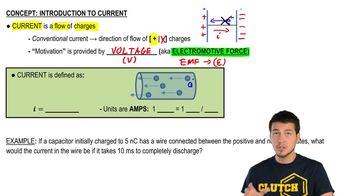
The total amount of charge in coulombs that has entered a wire at time t is given by the expression Q=4t−t2, where t is in seconds and t≥0. Find an expression for the current in the wire at time .
Verified step by step guidance
Verified video answer for a similar problem:
Key Concepts
Electric Charge
Current
Differentiation
You need to design a 1.0 A fuse that 'blows' if the current exceeds 1.0 A. The fuse material in your stockroom melts at a current density of 500 A/cm2. What diameter wire of this material will do the job?
The total amount of charge in coulombs that has entered a wire at time t is given by the expression Q=4t−t2, where t is in seconds and t≥0. Graph I versus t for the interval 0≤t≤4 s.
A hollow metal cylinder has inner radius a, outer radius b, length L, and conductivity σ. The current I is radially outward from the inner surface to the outer surface. Evaluate the electric field strength at the inner and outer surfaces of an iron cylinder if a=1.0 cm, b=2.5 cm, L=10 cm, and I=25 A.
The current supplied by a battery slowly decreases as the battery runs down. Suppose that the current as a function of time is . What is the total number of electrons transported from the positive electrode to the negative electrode by the charge escalator from the time the battery is first used until it is completely dead?
The total amount of charge that has entered a wire at time t is given by the expression , where t is in seconds and t≥0. What is the maximum value of the current?
