The electron drift speed in a 1.0-mm-diameter gold wire is 5.0 x 10⁻⁵ m/s. How long does it take 1 mole of electrons to flow through a cross section of the wire?

Ch 27: Current and Resistance
Knight Calc5th EditionPhysics for Scientists and EngineersISBN: 9780137344796Not the one you use?Change textbook
Chapter 27, Problem 7
The electron drift speed is 2.0 X 10⁻⁴ m/s in a metal with a mean time between collisions of 5.0 x 10⁻¹⁴. What is the electric field strength?
Verified step by step guidance1
Understand the relationship between the drift speed, electric field, and mean time between collisions. The drift speed \(v_d\) is related to the electric field \(E\) through the equation \(v_d = \mu E\), where \(\mu\) is the mobility of the electrons. Mobility \(\mu\) can be expressed as \(\mu = \frac{e \tau}{m}\), where \(e\) is the charge of an electron, \(\tau\) is the mean time between collisions, and \(m\) is the mass of an electron.
Substitute the expression for \(\mu\) into the drift speed equation. This gives \(v_d = \frac{e \tau}{m} E\). Rearrange this equation to solve for the electric field \(E\): \(E = \frac{v_d m}{e \tau}\).
Identify the known values: \(v_d = 2.0 \times 10^{-4} \ \text{m/s}\), \(\tau = 5.0 \times 10^{-14} \ \text{s}\), \(e = 1.6 \times 10^{-19} \ \text{C}\) (charge of an electron), and \(m = 9.11 \times 10^{-31} \ \text{kg}\) (mass of an electron).
Substitute the known values into the equation \(E = \frac{v_d m}{e \tau}\). This becomes \(E = \frac{(2.0 \times 10^{-4})(9.11 \times 10^{-31})}{(1.6 \times 10^{-19})(5.0 \times 10^{-14})}\).
Simplify the expression to calculate the electric field \(E\). Perform the arithmetic operations step by step to ensure accuracy, but do not compute the final value here.

Verified video answer for a similar problem:
This video solution was recommended by our tutors as helpful for the problem above.
Video duration:
3mWas this helpful?
Key Concepts
Here are the essential concepts you must grasp in order to answer the question correctly.
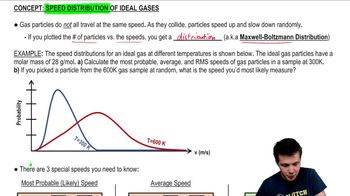
Drift Speed
Drift speed refers to the average velocity that a charged particle, such as an electron, attains due to an electric field. In conductive materials, electrons move randomly but, when an electric field is applied, they gain a net velocity in the direction of the field. This drift speed is typically very small, as seen in the given value of 2.0 x 10⁻⁴ m/s.
Recommended video:
Guided course
Speed Distribution & Special Speeds of Ideal Gases
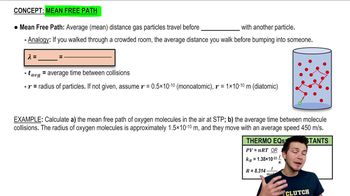
Mean Time Between Collisions
The mean time between collisions is the average time interval that an electron travels before colliding with an atom in the metal. This parameter is crucial for understanding the behavior of charge carriers in a conductor, as it affects their mobility and the overall conductivity of the material. In this case, the mean time is given as 5.0 x 10⁻¹⁴ seconds.
Recommended video:
Guided course
Mean Free Path
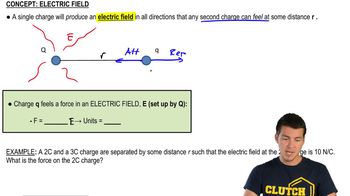
Electric Field Strength
Electric field strength, often denoted as E, is defined as the force per unit charge experienced by a positive test charge placed in the field. It is related to the drift speed and mean time between collisions through the equation E = (drift speed) / (mean time between collisions) multiplied by the charge-to-mass ratio of the electron. Understanding this relationship is essential for calculating the electric field strength in the given scenario.
Recommended video:
Guided course
Intro to Electric Fields
Related Practice
Textbook Question
Textbook Question
The mean time between collisions for electrons in a gold wire is 25 fs, where 1 fs = 1 femtosecond = 10⁻¹⁵ s. How many times does the electron collide with an ion while moving this distance?
2
views
Textbook Question
A superconducting magnet carries a 100 A current through a 0.50-mm-diameter superconducting wire that is wound into a coil. How much charge flows through the wire in 15 minutes?
1
views
Textbook Question
1.0 x 10²⁰ electrons flow through a cross section of a 2.0-mm-diameter iron wire in 5.0 s. What is the electron drift speed?
1
views
Textbook Question
The mean time between collisions for electrons in a gold wire is 25 fs, where 1 fs = 1 femtosecond = 10⁻¹⁵ s. What is the electron drift speed in a 35 mV/m electric field?
1
views