
Ch 27: Current and Resistance
Knight Calc - Physics for Scientists and Engineers 5th Edition
Knight Calc5th EditionPhysics for Scientists and EngineersISBN: 9780137344796Not the one you use?Change textbook
Chapter 27, Problem 46a

The biochemistry that takes place inside cells depends on various elements, such as sodium, potassium, and calcium, that are dissolved in water as ions. These ions enter cells through narrow pores in the cell membrane known as ion channels. Each ion channel, which is formed from a specialized protein molecule, is selective for one type of ion. Measurements with microelectrodes have shown that a 0.30-nm-diameter potassium ion (K+) channel carries a current of 1.8 pA. How many potassium ions pass through if the ion channel opens for 1.0 ms?

Verified step by step guidance
1
Step 1: Understand the problem. The goal is to determine how many potassium ions (K⁺) pass through the ion channel in a given time. The current carried by the channel is 1.8 pA, the time the channel is open is 1.0 ms, and the charge of a single potassium ion is equal to the elementary charge (e = 1.6 × 10⁻¹⁹ C).
Step 2: Use the relationship between current, charge, and time. The formula to calculate the total charge (Q) passing through the channel is: Q=It, where I is the current and t is the time.
Step 3: Substitute the given values into the formula. The current is 1.8 pA (1.8 × 10⁻¹² A), and the time is 1.0 ms (1.0 × 10⁻³ s). Calculate the total charge Q using the formula: Q=(1.8×10-12)×(1.0×10-3).
Step 4: Determine the number of potassium ions. The total charge Q is carried by individual potassium ions, each with a charge equal to the elementary charge e. The number of ions (N) can be calculated using the formula: N=Qe, where e = 1.6 × 10⁻¹⁹ C.
Step 5: Substitute the value of Q from Step 3 and the value of e into the formula for N. Simplify the expression to find the number of potassium ions that pass through the channel.

Verified video answer for a similar problem:

This video solution was recommended by our tutors as helpful for the problem above.
Was this helpful?

Key Concepts

Here are the essential concepts you must grasp in order to answer the question correctly.

Ion Channels

Ion channels are specialized protein structures embedded in cell membranes that allow specific ions to pass in and out of cells. They are selective, meaning each channel typically permits only one type of ion, such as potassium (K<sup>+</sup>), to flow through. This selectivity is crucial for maintaining the cell's electrochemical gradient and facilitating various cellular processes.

Current and Charge

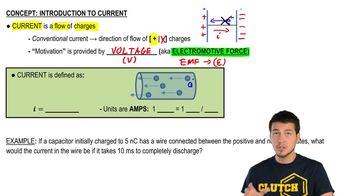
Electric current is the flow of electric charge, measured in amperes (A). In the context of ion channels, the current carried by ions can be quantified in picoamperes (pA), where 1 pA equals 10<sup>-12</sup> A. The relationship between current, charge, and time is essential for calculating the total number of ions that pass through a channel over a given period.
Recommended video:
Guided course
05:38
Intro to Current

Calculating Ion Flow

To determine the number of ions passing through an ion channel, one can use the formula: total charge (Q) = current (I) × time (t). Since each ion carries a fundamental charge (approximately 1.6 × 10<sup>-19</sup> coulombs), dividing the total charge by the charge of a single ion provides the total number of ions that have traversed the channel during the specified time interval.
Recommended video:
Guided course
11:08
Flow Continuity
Related Practice
Textbook Question

A sculptor has asked you to help electroplate gold onto a brass statue. You know that the charge carriers in the ionic solution are singly charged gold ions, and you've calculated that you must deposit 0.50 g of gold to reach the necessary thickness. How much current do you need, in mA, to plate the statue in 3.0 hours?

Textbook Question

The electron beam inside an old television picture tube is 0.40 mm in diameter and carries a current of 50 μA. This electron beam impinges on the inside of the picture tube screen. How many electrons strike the screen each second?

1
views
Textbook Question

Thermistors, resistors whose resistance is a sensitive function of temperature, are widely used in industry and consumer devices to measure temperature. The resistance of a thermistor at temperature T can be modeled as R=R₀exp[β(1/T−1/T₀)], where T₀ is a reference temperature, the temperatures are in K, and β is a constant with units of K. Suppose you connect a thermistor to a 10.0 V battery and measure the current through it at different temperatures. At 25.0°C, which you select as your reference temperature, the current is 10.0 mA. Raising the temperature to 30.0°C causes the current to increase to 12.5 mA. What is the value of β?

2
views
Textbook Question

Electrical engineers sometimes use a wire's conductance, G=σA/L, instead of its resistance. A 1.5 A current flows through the wire of part b. What is the potential difference between the ends of the wire?

1
views
Textbook Question

Variations in the resistivity of blood can give valuable clues about changes in various properties of the blood. Suppose a medical device inserts microelectrodes into a 1.5-mm-diameter vein at positions 5.0 cm apart. What is the blood resistivity if a 9.0 V potential difference causes a 230 μA current through the blood in the vein?

1
views
Textbook Question

Electrical engineers sometimes use a wire's conductance, G=σA/L, instead of its resistance. What is the conductance of a 5.4-cm-long, 0.15-mm-diameter tungsten wire?

2
views