Ch 27: Current and Resistance
Knight Calc - Physics for Scientists and Engineers 5th Edition
Knight Calc5th EditionPhysics for Scientists and EngineersISBN: 9780137344796Not the one you use?Change textbook
Chapter 27, Problem 26a

A 1.5 V battery provides 0.50 A of current. At what rate (C/s) is charge lifted by the charge escalator?

Verified step by step guidance
1
Understand the relationship between current and charge. Current (I) is defined as the rate of flow of charge (Q) over time (t), expressed as: I=Qt.
Rearrange the formula to solve for the rate of charge flow (Q/t): Qt=I. This shows that the rate of charge flow is equal to the current.
Identify the given values in the problem: the current I is 0.50 A (amperes), and the voltage of the battery is 1.5 V. However, the voltage is not directly needed to calculate the rate of charge flow.
Substitute the given current value into the formula: Qt=0.50. This indicates that 0.50 C of charge flows per second.
Conclude that the rate at which charge is lifted by the charge escalator is numerically equal to the current, which is 0.50 C/s.

Verified video answer for a similar problem:

This video solution was recommended by our tutors as helpful for the problem above.
Was this helpful?

Key Concepts

Here are the essential concepts you must grasp in order to answer the question correctly.

Current (I)

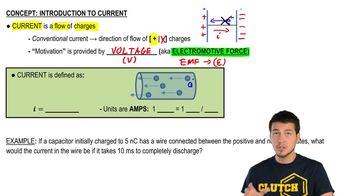
Current is the flow of electric charge in a circuit, measured in amperes (A). It represents the rate at which charge passes through a point in the circuit. In this case, a current of 0.50 A indicates that 0.50 coulombs of charge flow past a point every second.
Recommended video:
Guided course
05:38
Intro to Current

Charge (Q)

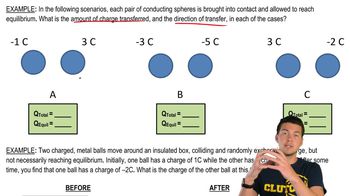
Charge is a fundamental property of matter that causes it to experience a force in an electromagnetic field. It is measured in coulombs (C). The relationship between current and charge can be expressed as Q = I × t, where Q is the total charge, I is the current, and t is the time in seconds.
Recommended video:
Guided course
05:43
Conservation of Charge

Rate of Charge Transfer

The rate of charge transfer refers to how quickly charge is moved through a system, typically expressed in coulombs per second (C/s). In this scenario, the rate at which charge is lifted by the charge escalator can be directly equated to the current, meaning that the charge escalator lifts charge at the same rate as the current flowing through the circuit.
Recommended video:
Guided course
05:14
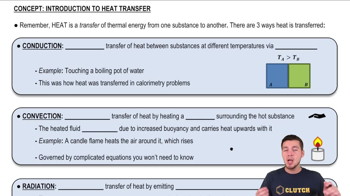
Overview of Heat Transfer