
Ch 25: The Electric Potential
Knight Calc - Physics for Scientists and Engineers 5th Edition
Knight Calc5th EditionPhysics for Scientists and EngineersISBN: 9780137344796Not the one you use?Change textbook
Chapter 25, Problem 44b

Living cells 'pump' singly ionized sodium ions, Na+, from the inside of the cell to the outside to maintain a membrane potential ΔVmembrane=Vin−Vout=−70 mV. It is called pumping because work must be done to move a positive ion from the negative inside of the cell to the positive outside, and it must go on continuously because sodium ions 'leak' back through the cell wall by diffusion. At rest, the human body uses energy at the rate of approximately 100 W to maintain basic metabolic functions. It has been estimated that 20% of this energy is used to operate the sodium pumps of the body. Estimate—to one significant figure—the number of sodium ions pumped per second.

Verified step by step guidance
1
Determine the total power used by the sodium pumps. Since 20% of the body's total power (100 W) is used for sodium pumps, calculate this fraction: \( P_{\text{sodium}} = 0.2 \times 100 \text{ W} \).
Calculate the work done to pump a single sodium ion. The work is given by \( W = q \Delta V_{\text{membrane}} \), where \( q \) is the charge of a single sodium ion (\( q = 1.6 \times 10^{-19} \text{ C} \)) and \( \Delta V_{\text{membrane}} = -70 \text{ mV} \) (convert to volts: \( -70 \times 10^{-3} \text{ V} \)).
Find the number of sodium ions pumped per second. The power used by the sodium pumps is related to the work done per ion and the number of ions pumped per second: \( P_{\text{sodium}} = n \cdot W \), where \( n \) is the number of ions per second. Rearrange to solve for \( n \): \( n = \frac{P_{\text{sodium}}}{W} \).
Substitute the values for \( P_{\text{sodium}} \) and \( W \) into the equation for \( n \). Ensure all units are consistent (e.g., power in watts, work in joules).
Estimate \( n \) to one significant figure. This will give the approximate number of sodium ions pumped per second by the sodium pumps in the body.

Verified video answer for a similar problem:

This video solution was recommended by our tutors as helpful for the problem above.
Video duration:
5m
Was this helpful?

Key Concepts

Here are the essential concepts you must grasp in order to answer the question correctly.

Membrane Potential

Membrane potential refers to the voltage difference across a cell's membrane, resulting from the distribution of ions inside and outside the cell. In this context, a resting membrane potential of -70 mV indicates that the inside of the cell is more negative compared to the outside. This potential is crucial for various cellular processes, including the generation of action potentials in neurons and muscle cells.
Recommended video:
Guided course
07:33
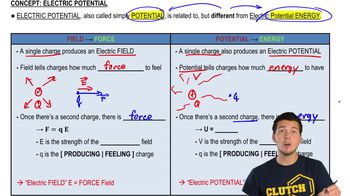
Electric Potential

Sodium-Potassium Pump

The sodium-potassium pump is a vital membrane protein that actively transports sodium ions (Na+) out of the cell and potassium ions (K+) into the cell, using ATP as an energy source. This pump is essential for maintaining the resting membrane potential and cellular homeostasis. By moving three sodium ions out for every two potassium ions moved in, it creates a concentration gradient that is critical for nerve impulse transmission and muscle contraction.
Recommended video:

Energy Consumption in Cells

Cells consume energy to perform various functions, including maintaining ion gradients across their membranes. In the human body, approximately 20% of the total energy expenditure is dedicated to operating sodium pumps, which is significant given the body's resting energy use of about 100 W. Understanding this energy allocation helps in estimating the number of ions pumped, as it links the energy used to the work done in moving ions against their concentration gradients.
Recommended video:
Guided course
04:10
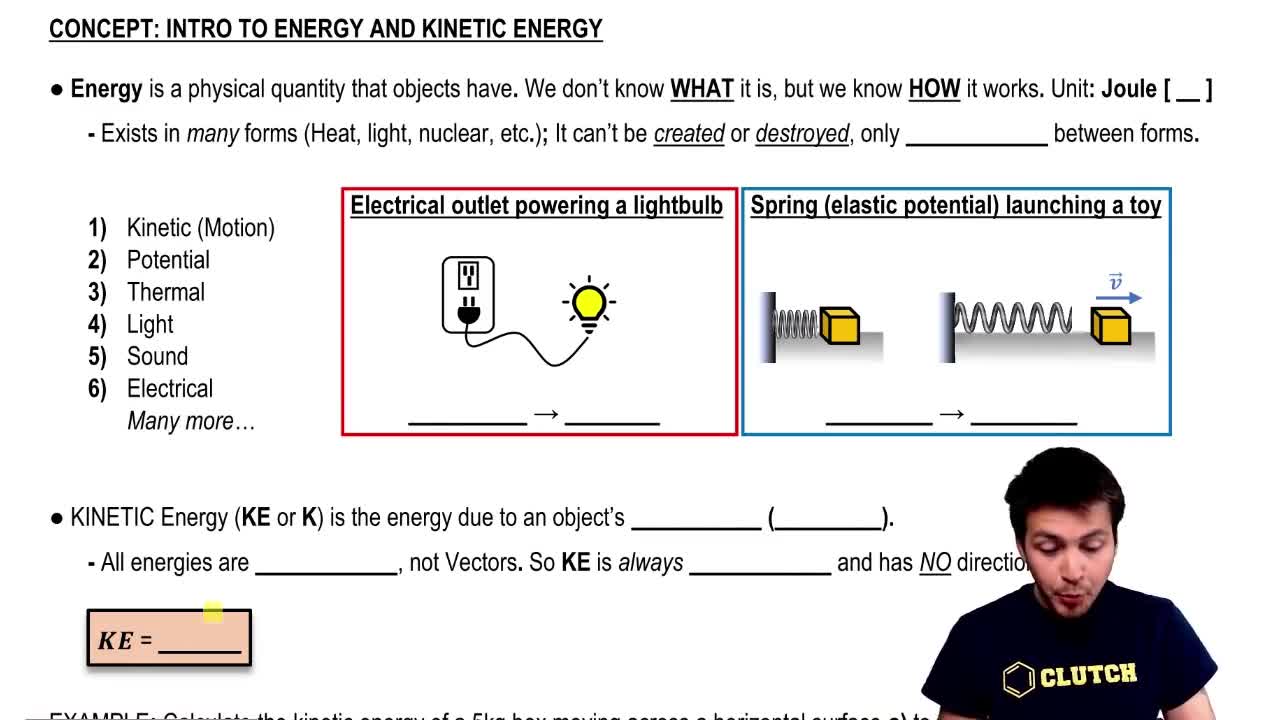
Intro to Energy & Types of Energy
Related Practice
Textbook Question

The electron gun in an old TV picture tube accelerates electrons between two parallel plates 1.2 cm apart with a 25 kV potential difference between them. The electrons enter through a small hole in the negative plate, accelerate, then exit through a small hole in the positive plate. Assume that the holes are small enough not to affect the electric field or potential. With what speed does an electron exit the electron gun if its entry speed is close to zero?

1
views
Textbook Question

A proton's speed as it passes point 1 is 50,000 m/s. It follows the trajectory shown in FIGURE P25.43. What is the proton's speed at point 2?

1
views
Textbook Question

An arrangement of source charges produces the electric potential V=5000x2 along the x-axis, where V is in volts and x is in meters. What is the maximum speed of a 1.0 g, 10 nC charged particle that moves in this potential with turning points at ±8.0 cm?

1
views
Textbook Question

A room with 3.0-m-high ceilings has a metal plate on the floor with V=0 V and a separate metal plate on the ceiling. A 1.0 g glass ball charged to +4.9 nC is shot straight up at 5.0 m/s. How high does the ball go if the ceiling voltage is +3.0×10⁶ V?

Textbook Question

A −3.0 nC charge is on the x-axis at x=−9 cm and a +4.0 nC charge is on the x-axis at x=16 cm. At what point or points on the y-axis is the electric potential zero?

11
views
Textbook Question

The four 1.0 g spheres shown in FIGURE P25.42 are released simultaneously and allowed to move away from each other. What is the speed of each sphere when they are very far apart?

1
views