Ch 25: The Electric Potential
Knight Calc - Physics for Scientists and Engineers 5th Edition
Knight Calc5th EditionPhysics for Scientists and EngineersISBN: 9780137344796Not the one you use?Change textbook
Chapter 25, Problem 28

A 1.0-mm-diameter ball bearing has 2.0×10⁹ excess electrons. What is the ball bearing's potential?

Verified step by step guidance
1
Determine the charge on the ball bearing by multiplying the number of excess electrons by the elementary charge. Use the formula: q=ne, where n is the number of excess electrons and e is the elementary charge (approximately 1.6×10⁻¹⁹ C).
Calculate the radius of the ball bearing from its diameter. The radius is half the diameter: r=d2, where d is the diameter (1.0 mm or 1.0×10⁻³ m).
Use the formula for the electric potential on the surface of a sphere: V=kqr, where k is Coulomb's constant (8.99×10⁹ N·m²/C²), q is the charge, and r is the radius of the ball bearing.
Substitute the values for q, r, and k into the formula for V. Ensure all units are consistent (e.g., meters for radius and Coulombs for charge).
Simplify the expression to find the electric potential V on the surface of the ball bearing. This will give the final result in volts (V).

Verified video answer for a similar problem:

This video solution was recommended by our tutors as helpful for the problem above.
Video duration:
2m
Was this helpful?

Key Concepts

Here are the essential concepts you must grasp in order to answer the question correctly.

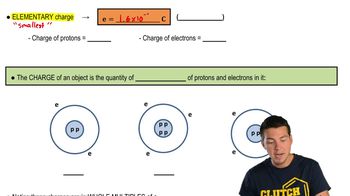
Electric Charge

Electric charge is a fundamental property of matter that causes it to experience a force when placed in an electromagnetic field. Charges can be positive or negative, with electrons carrying a negative charge. The total charge of an object is the sum of its positive and negative charges, and in this case, the ball bearing has an excess of electrons, indicating a net negative charge.
Recommended video:
Guided course
05:37
Electric Charge

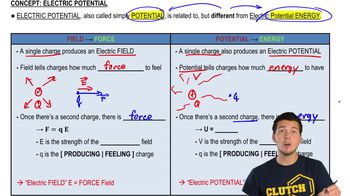
Electric Potential

Electric potential, often referred to as voltage, is the amount of electric potential energy per unit charge at a point in an electric field. It is measured in volts (V) and represents the work done to move a charge from a reference point to a specific point in the field. The potential of the ball bearing can be calculated using the formula V = k * Q / r, where k is Coulomb's constant, Q is the total charge, and r is the distance from the charge.
Recommended video:
Guided course
07:33
Electric Potential

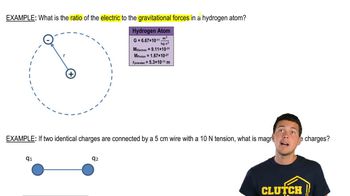
Coulomb's Law

Coulomb's Law describes the force between two charged objects and is fundamental in electrostatics. It states that the force between two point charges is directly proportional to the product of the magnitudes of the charges and inversely proportional to the square of the distance between them. This law helps in understanding how the excess electrons on the ball bearing influence its electric potential and the forces it may exert on other charges.
Recommended video:
Guided course
09:52
Coulomb's Law