
Ch 24: Gauss' Law
Knight Calc - Physics for Scientists and Engineers 5th Edition
Knight Calc5th EditionPhysics for Scientists and EngineersISBN: 9780137344796Not the one you use?Change textbook
Chapter 24, Problem 44

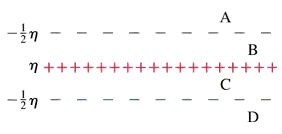
The three parallel planes of charge shown in FIGURE P24.44 have surface charge densities ─ ½ η , η , and ─ ½ η. Find the electric fields EA\(\overrightarrow{E_{A}\)} to ED\(\overrightarrow{E_{D}\)} in regions A to D. The upward direction is the + y-direction.
Diagram showing three parallel planes of charge with surface charge densities, labeled regions A to D for electric field analysis.

Verified step by step guidance
1
Step 1: Understand the problem setup. The three parallel planes of charge have surface charge densities of -½η, η, and -½η, respectively. The regions A, B, C, and D are defined as the spaces above the top plane, between the planes, and below the bottom plane. The goal is to calculate the electric field in each region, considering the upward direction as the +y-direction.
Step 2: Recall the formula for the electric field due to a plane of charge. The electric field produced by a plane of charge with surface charge density σ is given by: E=σ2εo, where ε₀ is the permittivity of free space. The direction of the field depends on the sign of the charge density: positive charge produces a field pointing away from the plane, and negative charge produces a field pointing toward the plane.
Step 3: Analyze the contributions to the electric field in region A (above the top plane). Only the top plane contributes to the field in this region. Use the formula for the electric field due to a plane of charge, and note that the field points downward because the top plane has a surface charge density of -½η.
Step 4: Analyze the contributions to the electric field in region B (between the top and middle planes). Both the top and middle planes contribute to the field in this region. Calculate the field due to each plane separately, considering their charge densities and directions, and then add the fields vectorially.
Step 5: Repeat the process for regions C (between the middle and bottom planes) and D (below the bottom plane). For region C, consider the contributions from the middle and bottom planes. For region D, only the bottom plane contributes to the field. Use the formula and add the fields vectorially, keeping track of the directions based on the charge densities.

Verified video answer for a similar problem:

This video solution was recommended by our tutors as helpful for the problem above.
Video duration:
12m
Was this helpful?

Key Concepts

Here are the essential concepts you must grasp in order to answer the question correctly.

Electric Field due to a Plane of Charge

The electric field generated by an infinite plane of charge is uniform and directed away from the plane if the charge is positive, and towards the plane if the charge is negative. The magnitude of the electric field (E) created by a plane with surface charge density (σ) is given by E = σ / (2ε₀), where ε₀ is the permittivity of free space. This principle is crucial for analyzing the contributions of each charged plane in the given problem.
Recommended video:
Guided course
06:28
Electric Field due to a Point Charge

Superposition Principle

The superposition principle states that the total electric field at a point due to multiple charge distributions is the vector sum of the electric fields produced by each distribution independently. In this scenario, the electric fields from each of the three charged planes must be calculated separately and then combined to find the resultant electric field in each region (A to D).
Recommended video:
Guided course
03:32
Superposition of Sinusoidal Wave Functions

Direction of Electric Fields

The direction of the electric field is determined by the nature of the charge creating it. For positive charges, the field lines point away from the charge, while for negative charges, they point towards the charge. Understanding the orientation of the electric fields in relation to the specified regions (A to D) is essential for correctly determining the net electric field in each area.
Recommended video:
Guided course
03:16
Intro to Electric Fields
Related Practice
Textbook Question

An infinitely wide, horizontal metal plate lies above a horizontal infinite sheet of charge with surface charge density 800 nC/m2. The bottom surface of the plate has surface charge density -100 nC/m2. What is the surface charge density on the top surface of the plate?

1
views
Textbook Question

An infinite slab of charge is centered in the xy-plane. It has charge density ρ=ρ0ez/ze\(\rho\)=\(\rho\)_0e^{-|z|/z_{e}}, where ρ₀ and z₀ are constants. This is a charge density that decreases exponentially as you move away from z = 0 in either the positive or negative direction. Find the electric field strength at distance z from the center of the slab.

1
views
Textbook Question

FIGURE P24.46 shows an infinitely wide conductor parallel to and distance d from an infinitely wide plane of charge with surface charge density η. What are the electric fields EA\(\overrightarrow{E_{A}\)} to ED\(\overrightarrow{E_{D}\)} in regions A to D?

1
views
Textbook Question

Figure 24.32b showed a conducting box inside a parallel-plate capacitor. The electric field inside the box is E=0\(\overrightarrow{E}\)=\(\overrightarrow{0}\). Suppose the surface charge on the exterior of the box could be frozen. Draw a picture of the electric field inside the box after the box, with its frozen charge, is removed from the capacitor. Hint: Superposition.

2
views
Textbook Question

An infinite slab of charge of thickness 2𝒵₀ lies in the xy-plane between 𝒵 = -𝒵₀ and 𝒵 = +𝒵₀ . The volume charge density p (C/m3) is a constant. Find an expression for the electric field strength above the slab (𝒵 ≥ 𝒵₀).

Textbook Question

The earth has a vertical electric field at the surface, pointing down, that averages 100 N/C. This field is maintained by various atmospheric processes, including lightning. What is the excess charge on the surface of the earth?