
Ch 24: Gauss' Law
Knight Calc - Physics for Scientists and Engineers 5th Edition
Knight Calc5th EditionPhysics for Scientists and EngineersISBN: 9780137344796Not the one you use?Change textbook
Chapter 24, Problem 61b

A spherical ball of charge has radius R and total charge Q. The electric field strength inside the ball (r ≤ R ) is E(r)=r4Emax/R4E(r)=r^4E_{max}/R^4. Find an expression for the volume charge density ρ(r) inside the ball as a function of r.

Verified step by step guidance
1
Step 1: Recall the relationship between the electric field and the charge density. Gauss's law in differential form states that the divergence of the electric field is proportional to the charge density: ∇·E = ρ/ε₀, where ρ is the volume charge density and ε₀ is the permittivity of free space.
Step 2: Write the expression for the electric field inside the ball, which is given as E(r) = (r⁴ Eₘₐₓ) / R⁴. Since the electric field is radially symmetric, we can use the spherical form of Gauss's law: (1/r²) ∂(r²E(r))/∂r = ρ(r)/ε₀.
Step 3: Compute the derivative of r²E(r) with respect to r. Start by multiplying the electric field E(r) by r²: r²E(r) = r² * (r⁴ Eₘₐₓ / R⁴) = r⁶ Eₘₐₓ / R⁴. Now, differentiate this expression with respect to r: ∂(r²E(r))/∂r = ∂(r⁶ Eₘₐₓ / R⁴)/∂r = 6r⁵ Eₘₐₓ / R⁴.
Step 4: Substitute the derivative into Gauss's law. Using (1/r²) ∂(r²E(r))/∂r = ρ(r)/ε₀, replace ∂(r²E(r))/∂r with 6r⁵ Eₘₐₓ / R⁴: (1/r²) * (6r⁵ Eₘₐₓ / R⁴) = ρ(r)/ε₀.
Step 5: Simplify the expression to find ρ(r). Combine terms: ρ(r) = ε₀ * (6r³ Eₘₐₓ / R⁴). This is the final expression for the volume charge density inside the ball as a function of r.

Verified video answer for a similar problem:

This video solution was recommended by our tutors as helpful for the problem above.
Video duration:
7m
Was this helpful?

Key Concepts

Here are the essential concepts you must grasp in order to answer the question correctly.

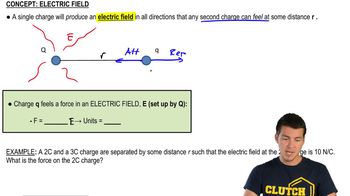
Electric Field

The electric field is a vector field that represents the force exerted by an electric charge on other charges in its vicinity. Inside a charged spherical object, the electric field varies with distance from the center, and in this case, it is given by E(r) = r⁴ Eₘₐₓ / R⁴, indicating that the field strength increases with the fourth power of the radius.
Recommended video:
Guided course
03:16
Intro to Electric Fields

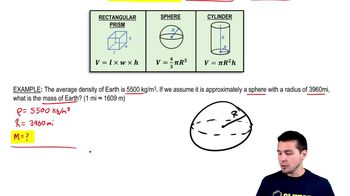
Volume Charge Density

Volume charge density (ρ) is defined as the amount of electric charge per unit volume within a specified region. It is crucial for understanding how charge is distributed within a volume, and can be derived from the electric field using Gauss's law, which relates the electric field to the charge enclosed within a Gaussian surface.
Recommended video:
Guided course
04:33
Problems with Mass, Volume, & Density

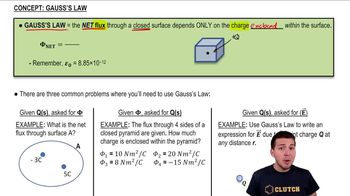
Gauss's Law

Gauss's Law states that the total electric flux through a closed surface is proportional to the enclosed electric charge. This principle is fundamental in electrostatics, allowing us to relate the electric field to charge distributions, particularly in symmetric situations like spherical charge distributions, which simplifies the calculation of electric fields and charge densities.
Recommended video: