Ch 24: Gauss' Law
Knight Calc - Physics for Scientists and Engineers 5th Edition
Knight Calc5th EditionPhysics for Scientists and EngineersISBN: 9780137344796Not the one you use?Change textbook
Chapter 24, Problem 36b

A 20-cm-radius ball is uniformly charged to 80 nC. How much charge is enclosed by spheres of radii 5, 10, and 20 cm?

Verified step by step guidance
1
Understand the problem: The ball is uniformly charged, meaning the charge is distributed evenly throughout its volume. To determine the charge enclosed by spheres of different radii, we need to use the concept of charge density and the relationship between the volume of a sphere and its radius.
Calculate the charge density (ρ): The charge density is the total charge divided by the total volume of the ball. The volume of a sphere is given by the formula: Vtotal = 43πR3, where R is the radius of the ball (20 cm). Use this to find ρ = QVtotal, where Q is the total charge (80 nC).
Relate the charge enclosed to the radius of the smaller spheres: For a sphere of radius r (where r ≤ R), the charge enclosed is proportional to the volume of that sphere. The volume of a smaller sphere is given by: Venclosed = 43πr3. The charge enclosed is then: Qenclosed = ρVenclosed.
Substitute the values for each radius: For r = 5 cm, 10 cm, and 20 cm, calculate the enclosed volume and then multiply by the charge density to find the enclosed charge. Use the formula: Qenclosed = QVtotalVenclosed.
Interpret the results: For r = 20 cm, the enclosed charge should equal the total charge (80 nC), since the sphere encompasses the entire ball. For r = 5 cm and 10 cm, the enclosed charge will be smaller, proportional to the cube of the radius. Ensure the results make sense based on the uniform charge distribution.

Verified video answer for a similar problem:

This video solution was recommended by our tutors as helpful for the problem above.
Was this helpful?

Key Concepts

Here are the essential concepts you must grasp in order to answer the question correctly.

Gauss's Law

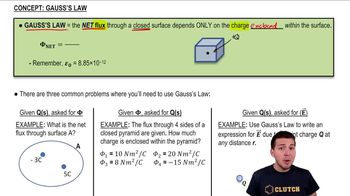
Gauss's Law states that the electric flux through a closed surface is proportional to the charge enclosed within that surface. Mathematically, it is expressed as Φ_E = Q_enc/ε₀, where Φ_E is the electric flux, Q_enc is the enclosed charge, and ε₀ is the permittivity of free space. This principle is fundamental for analyzing electric fields around charged objects.
Recommended video:

Electric Field of a Charged Sphere

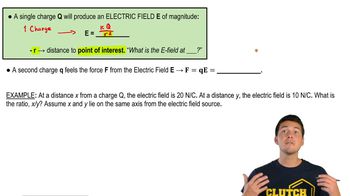
For a uniformly charged sphere, the electric field outside the sphere behaves as if all the charge were concentrated at the center. Inside the sphere, the electric field is zero. This concept is crucial for determining the electric field at various points relative to the charged sphere, particularly when applying Gauss's Law.
Recommended video:
Guided course
06:28
Electric Field due to a Point Charge

Charge Distribution

Charge distribution refers to how electric charge is spread over a given volume or surface. In this scenario, the ball is uniformly charged, meaning the charge is evenly distributed across its surface. Understanding charge distribution is essential for calculating the total charge enclosed within different spherical radii.
Recommended video:
Guided course
04:03
Probability Distribution Graph
Related Practice
Textbook Question

A spherically symmetric charge distribution produces the electric field E=(5000r2)r^\(\overrightarrow{E}\)=\(\left\)(5000r^2\(\right\))\(\hat{r}\) N/C, where r is in m. How much charge is inside this 40-cm-diameter spherical surface?

1
views

Textbook Question

An infinitely wide, horizontal metal plate lies above a horizontal infinite sheet of charge with surface charge density 800 nC/m2. The bottom surface of the plate has surface charge density -100 nC/m2. What is the surface charge density on the top surface of the plate?

1
views
Textbook Question

Charges q1=4Qq_1 = -4Q and q2=+2Qq_2 = +2Q are located at 𝓍=a𝓍 = -a and 𝓍=+a𝓍 = +a, respectively. What is the net electric flux through a sphere of radius 2a2a centered (a) at the origin and (b) at 𝓍=2a𝓍 = 2a?

1
views
Textbook Question

A 10 nC charge is at the center of a 2.0 m x 2.0 m x 2.0 m cube. What is the electric flux through the top surface of the cube?

23
views
Textbook Question

Figure 24.32b showed a conducting box inside a parallel-plate capacitor. The electric field inside the box is E=0\(\overrightarrow{E}\)=\(\overrightarrow{0}\). Suppose the surface charge on the exterior of the box could be frozen. Draw a picture of the electric field inside the box after the box, with its frozen charge, is removed from the capacitor. Hint: Superposition.

2
views
Textbook Question

The earth has a vertical electric field at the surface, pointing down, that averages 100 N/C. This field is maintained by various atmospheric processes, including lightning. What is the excess charge on the surface of the earth?