Ch 23: The Electric Field
Knight Calc - Physics for Scientists and Engineers 5th Edition
Knight Calc5th EditionPhysics for Scientists and EngineersISBN: 9780137344796Not the one you use?Change textbook
Chapter 23, Problem 37

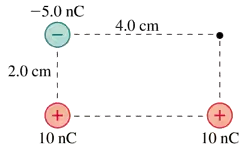
What are the strength and direction of the electric field at the position indicated by the dot in FIGURE P23.37? Give your answer (a) in component form and (b) as a magnitude and angle measured cw or ccw (specify which) from the positive x-axis.
Diagram showing charges of -5.0 nC and +10 nC arranged in a rectangle, with a dot indicating the position for electric field analysis.

Verified step by step guidance
1
Step 1: Identify the charges and their positions relative to the dot. The charges are: -5.0 nC at the top-left corner, +10 nC at the bottom-left corner, and +10 nC at the bottom-right corner. The distances from the dot to each charge are: 4.0 cm horizontally to the -5.0 nC charge, 2.0 cm vertically to the +10 nC charge at the bottom-left, and 4.0 cm horizontally to the +10 nC charge at the bottom-right.
Step 2: Use Coulomb's law to calculate the electric field contribution from each charge. The formula for the electric field due to a point charge is: E=kqr2, where k is the Coulomb constant (8.99×10⁹N·m2/C2), q is the charge, and r is the distance from the charge to the dot.
Step 3: Break the electric field contributions into components. For each charge, determine the direction of the electric field at the dot (away from positive charges and toward negative charges). Use trigonometry to resolve the electric field vectors into x and y components. For example, the electric field due to the -5.0 nC charge will have components in the negative x-direction, while the fields due to the +10 nC charges will have components in both x and y directions.
Step 4: Sum the components of the electric field. Add the x-components of the electric fields from all three charges to find the total x-component. Similarly, add the y-components of the electric fields to find the total y-component. This gives the electric field in component form: E=(Extotal,Eytotal).
Step 5: Calculate the magnitude and direction of the electric field. The magnitude is given by: E=Extotal2+Eytotal2. The direction (angle) is given by: θ=tan1(EytotalExtotal). Specify whether the angle is measured clockwise (cw) or counterclockwise (ccw) from the positive x-axis.

Verified video answer for a similar problem:

This video solution was recommended by our tutors as helpful for the problem above.
Was this helpful?

Key Concepts

Here are the essential concepts you must grasp in order to answer the question correctly.

Electric Field

The electric field is a vector field that represents the force exerted by an electric charge on other charges in its vicinity. It is defined as the force per unit charge and is directed away from positive charges and toward negative charges. The strength of the electric field (E) can be calculated using Coulomb's law, which states that the electric field due to a point charge is proportional to the charge and inversely proportional to the square of the distance from the charge.
Recommended video:
Guided course
03:16
Intro to Electric Fields

Vector Components

Vector components are the projections of a vector along the axes of a coordinate system, typically the x and y axes in two-dimensional space. To analyze electric fields, it is essential to break down the electric field vector into its components, allowing for easier calculations of net electric fields from multiple charges. The components can be calculated using trigonometric functions, where the x-component is found using cosine and the y-component using sine.
Recommended video:
Guided course
07:30
Vector Addition By Components

Magnitude and Direction

The magnitude of a vector is a measure of its size or strength, while the direction indicates where the vector points. In the context of electric fields, the magnitude can be calculated using the Pythagorean theorem from the vector components, and the direction can be expressed as an angle relative to a reference axis, such as the positive x-axis. This angle can be measured clockwise (cw) or counterclockwise (ccw), which is crucial for accurately describing the orientation of the electric field.
Recommended video:
Guided course
03:59
Calculating Magnitude & Components of a Vector
Related Practice
Textbook Question

Derive Equation 23.11 for the field Ē dipole in the plane that bisects an electric dipole.

2
views

Textbook Question

A proton is fired horizontally into a 1.0×10⁵ N/C vertical electric field. It rises 1.0 cm vertically after having traveled 5.0 cm horizontally. What was the proton's initial speed?

1
views
Textbook Question

Electrostatic cleaners remove small dust particles and pollen grains from air by first ionizing them, then flowing the air between the plates of a parallel-plate capacitor, parallel to the plates, where electric forces deposit charged particles on one of the electrodes. A typical pollen grain has a mass of 5.0×10105.0\(\times\)10^{-10} g, the ionizer charges it with 750750 extra electrons, and a fan moves the air at 3.03.0 m/s. Ignore air resistance and gravity. What minimum electric field strength is needed to deflect the grain by 3.03.0 mm before it leaves the electrodes?

2
views
Textbook Question

A −15 nC charge is at x=+2.0 cm on the x-axis. A second charge q is located somewhere on the x-axis to the left of the origin. The electric field at y=2.0 cm on the y-axis is E=3.0×10⁵i^\(\overrightarrow{E}\)=3.0\(\times\)10^5\(\hat{i}\)N/C . What are (a) the charge q in nC and (b) its distance from the origin?

1
views
Textbook Question

FIGURE P23.41 is a cross section of two infinite lines of charge that extend out of the page. Both have linear charge density λ. Find an expression for the electric field strength E at height y above the midpoint between the lines.

1
views
Textbook Question

The permanent electric dipole moment of the water molecule (H2O) is 6.2×10306.2\(\times\)10^{-30} Cm. What is the maximum possible torque on a water molecule in a 5.0×1085.0×10^8 N/C electric field?

3
views