
Textbook Question
Two equal point charges 2.5 cm apart, both initially neutral, are being charged at the rate of 5.0 nC/s. At what rate (N/s) is the force between them increasing 1.0 s after charging begins?

 Verified step by step guidance
 14:21
14:21
 10:19
10:19 05:10
05:10Two equal point charges 2.5 cm apart, both initially neutral, are being charged at the rate of 5.0 nC/s. At what rate (N/s) is the force between them increasing 1.0 s after charging begins?
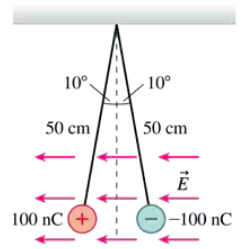
An electric field N/C causes the point charge in FIGURE P22.68 to hang at an angle. What is θ?
An electric dipole consists of two opposite charges separated by a small distance . The product is called the dipole moment. Figure P shows an electric dipole perpendicular to an electric field . Find an expression in terms of and for the magnitude of the torque that the electric field exerts on the dipole.
You have a lightweight spring whose unstretched length is 4.0 cm. First, you attach one end of the spring to the ceiling and hang a 1.0 g mass from it. This stretches the spring to a length of 5.0 cm. You then attach two small plastic beads to the opposite ends of the spring, lay the spring on a frictionless table, and give each plastic bead the same charge. This stretches the spring to a length of 4.5 cm. What is the magnitude of the charge (in nC) on each bead?
Three 1.0 nC charges are placed as shown in FIGURE P22.66. Each of these charges creates an electric field E at a point 3.0 cm in front of the middle charge. What are the three fields E₁, E₂, and E₃ created by the three charges? Write your answer for each as a vector in component form.
A 10.0 nC charge is located at position (x, y)=(1.0 cm, 2.0 cm). At what (x, y) position(s) is the electric field N/C?