
Ch 20: The Micro/Macro Connection
Knight Calc - Physics for Scientists and Engineers 5th Edition
Knight Calc5th EditionPhysics for Scientists and EngineersISBN: 9780137344796Not the one you use?Change textbook
Chapter 20, Problem 73a

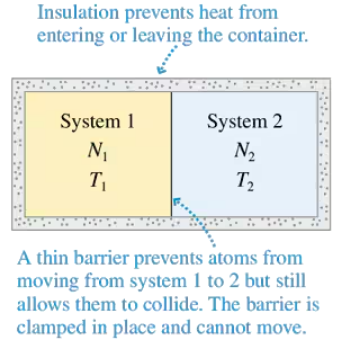
Consider a container like that shown in Figure, with n1n_1 moles of a monatomic gas on one side and n2n_2 moles of a diatomic gas on the other. The monatomic gas has initial temperature T1iT_{1i}. The diatomic gas has initial temperature T2iT_{2i}. Show that the equilibrium thermal energies are
E1f=3n13n1+5n2(E1i+E2i)E2f=5n23n1+5n2(E1i+E2i)\(\begin{aligned}\)E_{1f} &= \(\frac{3n_1}{3n_1 + 5n_2}\) (E_{1i} + E_{2i}) \(\E\)_{2f} &= \(\frac{5n_2}{3n_1 + 5n_2}\) (E_{1i} + E_{2i})\(\end{aligned}\)

Verified step by step guidance
1
Step 1: Understand the problem. The goal is to find the equilibrium thermal energies of the two gases in the container. The system consists of a monatomic gas (with n₁ moles and initial temperature T₁ᵢ) and a diatomic gas (with n₂ moles and initial temperature T₂ᵢ). At thermal equilibrium, the two gases will have the same final temperature, Tₑ, and their thermal energies will be related to their specific heat capacities.
Step 2: Recall the formula for the thermal energy of an ideal gas. For a monatomic gas, the thermal energy is given by: U=32nRT. For a diatomic gas, the thermal energy is given by: U=52nRT. These formulas are derived from the degrees of freedom of the gases (3 for monatomic and 5 for diatomic at room temperature).
Step 3: Write the total initial thermal energy of the system. The total initial energy is the sum of the thermal energies of the monatomic and diatomic gases: Ui=32n1RT1i+52n2RT2i.
Step 4: Write the total thermal energy at equilibrium. At equilibrium, the final temperature of both gases is the same (Tₑ). The total energy is: Ue=32n1RTe+52n2RTe.
Step 5: Use conservation of energy to solve for Tₑ. Since energy is conserved, the total initial energy equals the total energy at equilibrium: Ui=Ue. Substitute the expressions for Ui and Ue, and solve for Tₑ. Once Tₑ is found, substitute it back into the expressions for the thermal energies of each gas to find their equilibrium thermal energies.

Verified video answer for a similar problem:

This video solution was recommended by our tutors as helpful for the problem above.
Video duration:
9m
Was this helpful?

Key Concepts

Here are the essential concepts you must grasp in order to answer the question correctly.

Thermal Energy

Thermal energy is the total kinetic energy of the particles in a substance due to their motion. For an ideal gas, the thermal energy can be expressed as a function of temperature and the number of moles. In this context, the thermal energy of a gas is directly proportional to its temperature and the number of moles, which is crucial for understanding how energy is distributed between different gases in thermal equilibrium.
Recommended video:
Guided course
05:21
Volume Thermal Expansion

Equipartition of Energy

The equipartition theorem states that energy is distributed equally among all degrees of freedom in a system at thermal equilibrium. For a monatomic gas, each degree of freedom contributes rac{1}{2}kT to the thermal energy, while for a diatomic gas, it contributes rac{5}{2}kT due to additional rotational degrees of freedom. This concept is essential for calculating the final equilibrium temperatures and energies of the gases in the container.
Recommended video:
Guided course
04:10
Intro to Energy & Types of Energy

Thermal Equilibrium

Thermal equilibrium occurs when two or more systems in thermal contact reach the same temperature, resulting in no net heat flow between them. In the context of the question, the monatomic and diatomic gases will exchange energy until they reach a common final temperature. Understanding this concept is vital for analyzing how the initial temperatures and moles of each gas affect the final thermal energies in the system.
Recommended video:
Guided course
05:21
Volume Thermal Expansion
Related Practice
Textbook Question

Consider a container like that shown in the Figure, with n1n_1 moles of a monatomic gas on one side and n2n_2 moles of a diatomic gas on the other. The monatomic gas has initial temperature T1iT_{1i}. The diatomic gas has initial temperature T2iT_{2i}. Show that the equilibrium temperature is


Tf=3n1T1i+5n2T2i3n1+5n2T_f = \(\frac{3n_1 T_{1i}\) + 5n_2 T_{2i}}{3n_1 + 5n_2}

1
views
Textbook Question

A 2.0 mol sample of oxygen gas in a rigid, 15 L container is slowly cooled from 250℃ to 50℃ by being in thermal contact with a large bath of 50℃ water. What is the entropy change of (a) the gas and (b) the universe?

1
views
Textbook Question

An experiment you're designing needs a gas with γ = 1.50. You recall from your physics class that no individual gas has this value, but it occurs to you that you could produce a gas with γ = 1.50 by mixing together a monatomic gas and a diatomic gas. What fraction of the molecules need to be monatomic?

2
views
Textbook Question

A thin partition divides a container of volume V into two parts. One side contains nA moles of gas A in a fraction fA of the container; that is, VA = fAV. The other side contains nB moles of a different gas B at the same temperature in a fraction fB of the container. The partition is removed, allowing the gases to mix. Find an expression for the change of entropy. This is called the entropy of mixing.

Textbook Question

n1 moles of a monatomic gas and n2 moles of a diatomic gas are mixed together in a container. Derive an expression for the molar specific heat at constant volume of the mixture.

1
views