Ch 19: Work, Heat, and the First Law of Thermodynamics
Knight Calc - Physics for Scientists and Engineers 5th Edition
Knight Calc5th EditionPhysics for Scientists and EngineersISBN: 9780137344796Not the one you use?Change textbook
Chapter 19, Problem 52b

An ideal-gas process is described by p=cV1/2, where c is a constant. 0.033 mol of gas at an initial temperature of 150°C is compressed, using this process, from 300 cm3 to 200 cm3. How much work is done on the gas?

Verified step by step guidance
1
Step 1: Start by understanding the relationship given in the problem. The pressure is related to the volume by the equation \( p = cV^{\gamma} \), where \( \gamma = \frac{1}{2} \) and \( c \) is a constant. This indicates a polytropic process, where the work done can be calculated using the formula \( W = \frac{p_2V_2 - p_1V_1}{1 - \gamma} \).
Step 2: Convert the given initial temperature from Celsius to Kelvin. Use the formula \( T(K) = T(°C) + 273.15 \). For the initial temperature of 150°C, calculate \( T_1 \) in Kelvin.
Step 3: Use the ideal gas law \( pV = nRT \) to find the initial pressure \( p_1 \). Here, \( n = 0.033 \) mol, \( R = 8.314 \, \text{J/(mol·K)} \), \( T_1 \) is the initial temperature in Kelvin, and \( V_1 = 300 \, \text{cm}^3 = 0.0003 \, \text{m}^3 \). Solve for \( p_1 \).
Step 4: Use the relationship \( p = cV^{\gamma} \) to find the constant \( c \). Substitute \( p_1 \), \( V_1 \), and \( \gamma = \frac{1}{2} \) into the equation \( c = \frac{p_1}{V_1^{\gamma}} \). Then, use this constant to calculate \( p_2 \) at \( V_2 = 200 \, \text{cm}^3 = 0.0002 \, \text{m}^3 \) using \( p_2 = cV_2^{\gamma} \).
Step 5: Substitute \( p_1 \), \( V_1 \), \( p_2 \), \( V_2 \), and \( \gamma = \frac{1}{2} \) into the work formula \( W = \frac{p_2V_2 - p_1V_1}{1 - \gamma} \). Simplify the expression to find the work done on the gas.

Verified video answer for a similar problem:

This video solution was recommended by our tutors as helpful for the problem above.
Video duration:
6m
Was this helpful?

Key Concepts

Here are the essential concepts you must grasp in order to answer the question correctly.

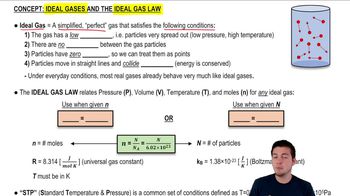
Ideal Gas Law

The Ideal Gas Law relates the pressure, volume, temperature, and amount of gas through the equation PV=nRT. It is essential for understanding the behavior of gases under various conditions. In this problem, the initial and final states of the gas are influenced by changes in volume and temperature, which can be analyzed using this law.
Recommended video:
Guided course
07:21
Ideal Gases and the Ideal Gas Law

Work Done on a Gas

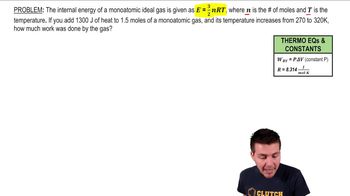
In thermodynamics, the work done on a gas during a compression or expansion process is calculated using the formula W = ∫PdV, where P is the pressure and dV is the change in volume. For this specific process, the pressure is defined by the equation p=cV^2, which must be integrated over the volume change to find the total work done.
Recommended video:
Guided course
03:47
Calculating Work Done on Monoatomic Gas

Thermodynamic Processes

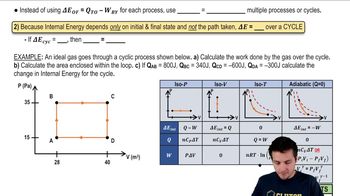
Thermodynamic processes describe how a system changes from one state to another, often involving heat transfer and work. In this case, the process is defined by a specific relationship between pressure and volume, indicating a non-isothermal compression. Understanding the type of process helps in applying the correct equations and principles to calculate work and other thermodynamic properties.
Recommended video:
Guided course
08:45
Properties of Cyclic Thermodynamic Processes