
Ch 18: A Macroscopic Description of Matter
Knight Calc - Physics for Scientists and Engineers 5th Edition
Knight Calc5th EditionPhysics for Scientists and EngineersISBN: 9780137344796Not the one you use?Change textbook
Chapter 18, Problem 66b

Five grams of nitrogen gas at an initial pressure of 3.0 atm and at 20°C undergo an isobaric expansion until the volume has tripled. What is the gas temperature after the expansion (in °C)? The gas pressure is then decreased at constant volume until the original temperature is reached.

Verified step by step guidance
1
Step 1: Start by identifying the given values for the first part of the problem. The initial pressure \( P_1 = 3.0 \; \text{atm} \), the initial temperature \( T_1 = 20^\circ \text{C} = 293.15 \; \text{K} \) (convert to Kelvin by adding 273.15), and the volume triples during the isobaric expansion, so \( V_2 = 3V_1 \).
Step 2: Use the ideal gas law relationship for an isobaric process, where \( \frac{T_2}{T_1} = \frac{V_2}{V_1} \). Since \( V_2 = 3V_1 \), substitute this into the equation to find \( T_2 \): \( T_2 = 3T_1 \).
Step 3: Substitute \( T_1 = 293.15 \; \text{K} \) into the equation \( T_2 = 3T_1 \) to calculate \( T_2 \) in Kelvin. After finding \( T_2 \) in Kelvin, convert it back to Celsius using \( T_2(\text{°C}) = T_2(\text{K}) - 273.15 \).
Step 4: For the second part of the problem, the gas undergoes a process at constant volume where the pressure decreases until the original temperature \( T_1 = 293.15 \; \text{K} \) is reached. Use the ideal gas law relationship for an isochoric process, \( \frac{P_2}{P_1} = \frac{T_2}{T_1} \).
Step 5: Substitute the known values \( P_1 = 3.0 \; \text{atm} \), \( T_2 \) (from the first part), and \( T_1 = 293.15 \; \text{K} \) into the equation \( P_2 = P_1 \cdot \frac{T_1}{T_2} \) to calculate the final pressure \( P_2 \).

Verified video answer for a similar problem:

This video solution was recommended by our tutors as helpful for the problem above.
Video duration:
5m
Was this helpful?

Key Concepts

Here are the essential concepts you must grasp in order to answer the question correctly.

Ideal Gas Law

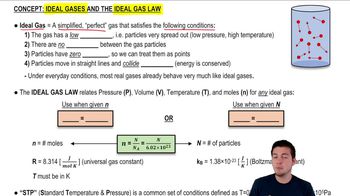
The Ideal Gas Law relates the pressure, volume, temperature, and number of moles of a gas through the equation PV = nRT. This law is fundamental in understanding the behavior of gases under various conditions, allowing us to calculate changes in temperature and pressure during processes like expansion and compression.
Recommended video:
Guided course
07:21
Ideal Gases and the Ideal Gas Law

Isobaric Process

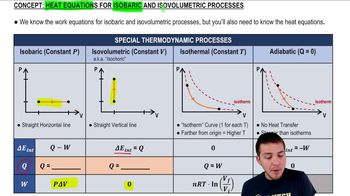
An isobaric process is a thermodynamic process in which the pressure remains constant while the volume and temperature of the gas change. In this scenario, as the nitrogen gas expands isobarically, its temperature increases, which can be calculated using the Ideal Gas Law, given the initial conditions and the final volume.
Recommended video:
Guided course
06:44
Heat Equations for Isobaric & Isovolumetric Processes

Charles's Law

Charles's Law states that the volume of a gas is directly proportional to its temperature (in Kelvin) when pressure is held constant. This principle is crucial for determining the final temperature of the gas after it has expanded, as it allows us to relate the initial and final states of the gas during the isobaric expansion.
Recommended video:
Related Practice
Textbook Question

An inflated bicycle inner tube is 2.2 cm in diameter and 200 cm in circumference. A small leak causes the gauge pressure to decrease from 110 psi to 80 psi on a day when the temperature is 20°C. What mass of air is lost? Assume the air is pure nitrogen.

2
views
Textbook Question

10 g of dry ice (solid CO₂) is placed in a 10,000 cm3 container, then all the air is quickly pumped out and the container sealed. The container is warmed to 0°C, a temperature at which CO₂ is a gas. What is the gas pressure? Give your answer in atm. The gas then undergoes an isothermal compression until the pressure is 3.0 atm, immediately followed by an isobaric compression until the volume is 1000 cm3.

1
views
Textbook Question

In Problems 67,68,69,67, 68, 69, and 7070 you are given the equation(s) used to solve a problem. For each of these, you are to write a realistic problem for which this is the correct equation(s).

(T2+273) K=200 kPa500 kPa×1×(400+273) K(T_2 + 273) \(\text{ K}\) = \(\frac{200 \text{ kPa}\)}{500 \(\text{ kPa}\)} \(\times\) 1 \(\times\) (400 + 273) \(\text{ K}\)

1
views
Textbook Question

In Problems 67,68,69,67, 68, 69, and 7070 you are given the equation(s) used to solve a problem. For each of these, you are to write a realistic problem for which this is the correct equation(s).

p2=300 cm3100 cm3×1×2 atmp_2 = \(\frac{300 \text{ cm}\)^3}{100 \(\text{ cm}\)^3} \(\times\) 1 \(\times\) 2 \(\text{ atm}\)

1
views
Textbook Question

A container of gas at 2.0 atm pressure and 127°C is compressed at constant temperature until the volume is halved. It is then further compressed at constant pressure until the volume is halved again. Show this process on a pV diagram.

2
views
Textbook Question

Five grams of nitrogen gas at an initial pressure of 3.0 atm and at 20°C undergo an isobaric expansion until the volume has tripled. What is the gas volume after the expansion?

1
views