Ch 18: A Macroscopic Description of Matter
Knight Calc - Physics for Scientists and Engineers 5th Edition
Knight Calc5th EditionPhysics for Scientists and EngineersISBN: 9780137344796Not the one you use?Change textbook
Chapter 18, Problem 3

A hollow aluminum sphere with outer diameter 10.0 cm has a mass of 690 g. What is the sphere's inner diameter?

Verified step by step guidance
1
Step 1: Start by calculating the volume of the hollow aluminum sphere. The formula for the volume of a sphere is \( V = \frac{4}{3} \pi r^3 \), where \( r \) is the radius. The outer radius \( r_{outer} \) can be found by dividing the outer diameter (10.0 cm) by 2.
Step 2: Use the density formula \( \rho = \frac{m}{V} \), where \( \rho \) is the density, \( m \) is the mass, and \( V \) is the volume. Look up the density of aluminum (approximately 2.70 g/cm³) and use it to calculate the total volume of aluminum in the sphere.
Step 3: Subtract the volume of the hollow part from the total volume of the sphere to find the volume of the aluminum material. The volume of the hollow part is \( V_{hollow} = \frac{4}{3} \pi r_{inner}^3 \), where \( r_{inner} \) is the inner radius.
Step 4: Rearrange the formula for the volume of the hollow part to solve for \( r_{inner} \). Use the relationship \( V_{aluminum} = V_{outer} - V_{hollow} \) to isolate \( r_{inner} \).
Step 5: Once \( r_{inner} \) is calculated, multiply it by 2 to find the inner diameter of the sphere. Ensure all units are consistent throughout the calculation (e.g., cm³ for volume, cm for radius).

Verified video answer for a similar problem:

This video solution was recommended by our tutors as helpful for the problem above.
Video duration:
9m
Was this helpful?

Key Concepts

Here are the essential concepts you must grasp in order to answer the question correctly.

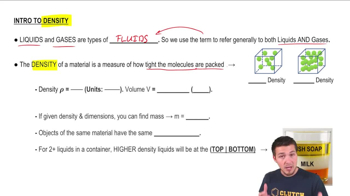
Density

Density is defined as mass per unit volume and is a crucial property of materials. For aluminum, the density is approximately 2.7 g/cm³. Understanding density allows us to relate the mass of the hollow sphere to its volume, which is essential for determining the inner diameter.
Recommended video:
Guided course
8:13
Intro to Density

Volume of a Sphere

The volume of a sphere is calculated using the formula V = (4/3)πr³, where r is the radius. In the case of a hollow sphere, we need to consider both the outer and inner radii to find the volume of the material. This concept is vital for solving the problem as it helps in determining the inner diameter from the given mass and outer diameter.
Recommended video:
Guided course
05:21
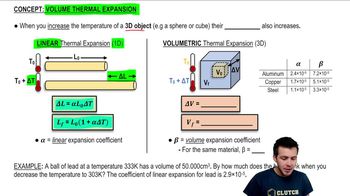
Volume Thermal Expansion

Mass and Volume Relationship

The relationship between mass, volume, and density is expressed by the equation mass = density × volume. This relationship allows us to calculate the volume of the hollow sphere using its mass and the known density of aluminum. By rearranging this equation, we can find the inner diameter once we have the volume of the hollow part.
Recommended video:
Guided course
05:21
Volume Thermal Expansion